
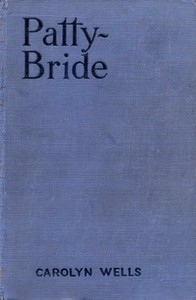
Patty—Bride
Written by Carolyn Wells
Chaptra reads alongside you — AI insights, chapter breakdowns and reader discussions for every book. Join free
About this book
Read it with a club
Chaptra's history and war clubs — small groups reading the same books and talking as they go.


Footnotes & Firefights
History and war
- 4 members
- 4 discussions
- Active Sep 11
Military history, from grand strategy down to the deeply boring logistics that actually decided everything. This is a Chaptra house club — set up and moderated by us to get the conversation going. Open to everyone; jump in anywhere.
Read Patty—Bride alongside people who are reading it too.
Also here: Empire, Reconsidered
Chaptra Prime — paid clubs, every club feature, and unlimited reading support, for $5 a month or $60 once.
See PrimeReading guide
Themes, characters and key ideas in Patty—Bride, written by Chaptra AI.
- about 8 hours
- intermediate
- romantic
- humorous
- dramatic
Carolyn Wells's "Patty—Bride" is an early 20th-century novel chronicling the romantic dilemmas of Patricia "Patty" Fairfield as she prepares for her marriage to Bill Farnsworth. The narrative is primarily driven by the persistent affections of Philip Van Reypen, who refuses to relinquish his hope of winning Patty's heart, despite her engagement. Against a backdrop of evolving societal expectations and personal desires, Patty's journey explores themes of loyalty, love, and self-discovery. The story blends humor and drama, offering a glimpse into the complexities of relationships during a transitional period for women's roles and romantic conventions, ultimately leading Patty to confront her own feelings and make a definitive choice about her future.
“"My dear Patty, you cannot expect me to simply step aside because you have made a conventional choice. My heart will not allow it."”
Key themes
- Love vs. Duty/Societal Expectation
- This is the core theme of the novel, explored through Patty's dilemma. She is engaged to Bill, fulfilling a societal expectation of a sensible match, but is drawn to the passionate, insistent Philip. The theme delves into the conflict between what society dictates as proper or secure in marriage versus the individual's desire for true, perhaps more tumultuous, love.
- Female Agency and Self-Discovery
- The novel explores Patty's journey of understanding her own desires and making an autonomous choice in an era where women's roles were largely defined by marriage. Her internal struggle is a quest for self-knowledge, moving beyond external pressures to identify what she truly wants for her life and who she truly loves.
- The Nature of Love (Passion vs. Steadfastness)
- This theme directly contrasts the two suitors: Bill, who represents a steady, reliable, and perhaps less thrilling form of love, and Philip, who embodies passionate, intense, and potentially tumultuous affection. Patty's decision forces a consideration of which form of love is more desirable or sustainable for a lifelong commitment.
Worth discussing
How do societal expectations of marriage in the early 20th century influence Patty's decisions, and how do these compare to modern expectations?
Chapter-by-chapter breakdowns, character arcs and the full thematic analysis come with a free account.
Discussions
No one has started one yet
Questions this book opens up
No discussions yet
Be the first to start a discussion about this book!
Sign up to start the discussionReviews
No reviews yet
Be the first to review this book!