
About this book
Reading guide
Themes, characters and key ideas in Parodies of the works of English & American authors, vol. V, written by Chaptra AI.
- about 10 hours
- advanced
- humorous
- satirical
- witty
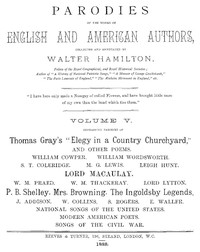
This volume, "Parodies of the works of English & American authors, vol. V," serves as a fascinating anthology celebrating the art of literary parody. Lacking a singular narrative or author, it presents a collection of satirical pieces that mimic and playfully critique the distinctive styles, thematic preoccupations, and structural conventions of various prominent English and American writers. The book functions as both an homage and a critical commentary, requiring readers to possess a degree of familiarity with the original works to fully appreciate the wit and insight embedded within each parody. It highlights the enduring power of satire to illuminate the eccentricities and genius of literary masters across different eras.
“It was, as one might expect from such a mind, a particularly long sentence, winding through clauses and sub-clauses like a river determined to reach the sea by the most circuitous route imaginable, only to find itself back near its source, pondering the futility of ambition.”
Key themes
- Literary Criticism and Satire
- This is the overarching theme, as the entire volume is a testament to parody as a form of critical commentary. Each piece dissects, exaggerates, and often gently mocks the stylistic quirks, narrative habits, and philosophical leanings of established authors. It provides an alternative, often more engaging, form of critique that requires the reader's active participation in recognizing the original text and appreciating the parodist's insight into its construction.
- Intertextuality and Homage
- The collection inherently explores the concept of intertextuality—the relationship between texts—as each parody is deeply embedded in its source material. It's a dialogue with the past, a recognition of literary lineage. While critical, parody is also a form of homage, acknowledging the impact and memorability of the parodied works. The humor often arises from a shared cultural understanding and affection for the original, making the critique feel more like a playful jab than outright dismissal.
- The Evolution of Literary Style
- By showcasing parodies of authors from different periods (e.g., Romantic, Victorian, American Realist), the collection implicitly charts the evolution of literary styles, conventions, and prevailing sensibilities. It highlights how certain stylistic choices become dominant, then potentially cliché, and how authors push boundaries or adhere to established norms. The parodies, by exaggerating these styles, make their distinctiveness and historical context more apparent.
Worth discussing
What defines a successful literary parody, and how does it differ from mere imitation?
Chapter-by-chapter breakdowns, character arcs and the full thematic analysis come with a free account.
Discussions
No one has started one yet
Questions this book opens up
No discussions yet
Be the first to start a discussion about this book!
Sign up to start the discussionReviews
No reviews yet
Be the first to review this book!