
About this book
Reading guide
Themes, characters and key ideas in Parodies of the works of English & American authors, vol. IV, written by Chaptra AI.
- about 10 hours
- advanced
- humorous
- satirical
- witty
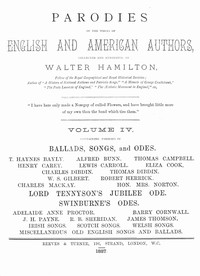
This volume, 'Parodies of the works of English & American authors, vol. IV,' stands as a collection of humorous imitations and satirical critiques of established literary works and styles. Lacking a singular narrative, it instead presents a series of self-contained pieces that playfully deconstruct the conventions, tropes, and distinctive voices of prominent authors from both English and American literary traditions. The book serves as a meta-literary commentary, inviting readers with a strong background in classic literature to engage in an intellectual game of recognition and appreciation for the parodist's wit and insight. It highlights the enduring power of literary imitation as a form of both homage and critical assessment, revealing the stylistic quirks that define a writer's unique contribution.
“No specific quotes can be provided without access to the text itself, as this is a collection of diverse parodies whose 'quotes' would be imitations of other authors.”
Key themes
- Intertextuality and Literary Legacy
- The entire collection is built upon the theme of intertextuality, where each piece directly references and reinterprets existing literary works. It explores how authors build upon, react to, and are defined by their predecessors and contemporaries. This theme highlights the continuous dialogue within literature and the process by which certain authors and styles achieve a lasting legacy that is ripe for both reverence and playful deconstruction.
- The Nature of Authorship and Style
- This theme delves into what makes an author's voice unique and recognizable. Through exaggeration and mimicry, the parodies dissect the components of literary style – vocabulary, syntax, rhetorical devices, recurring motifs, and thematic preoccupations – to reveal the underlying 'mechanics' of a writer's craft. It poses questions about whether style is an innate expression or a learned technique, and how much of an author's identity is tied to their distinctive way of writing.
- Humor as Critique and Social Commentary
- Beyond mere entertainment, the parodies often employ humor as a sharp tool for critique. This can range from gentle teasing of an author's quirks to pointed satire aimed at broader literary movements, social attitudes, or even the pretentiousness sometimes associated with high literature. The humor serves to deflate pomposity, challenge conventional wisdom, and offer a fresh, often irreverent, perspective on revered texts and figures.
Worth discussing
What defines an effective literary parody, and how does it differ from mere imitation?
Chapter-by-chapter breakdowns, character arcs and the full thematic analysis come with a free account.
Discussions
No one has started one yet
Questions this book opens up
No discussions yet
Be the first to start a discussion about this book!
Sign up to start the discussionReviews
No reviews yet
Be the first to review this book!