
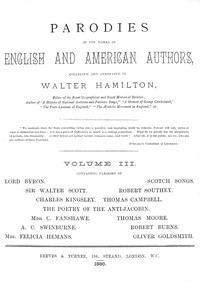
About this book
Reading guide
Themes, characters and key ideas in Parodies of the works of English & American authors, vol. III, written by Chaptra AI.
- about 10 hours
- advanced
- humorous
- satirical
- witty
This collection, 'Parodies of the works of English & American authors, vol. III,' serves as a witty and insightful exploration of literary tradition through the lens of humor and satire. Comprising a diverse array of pieces, each work meticulously imitates and exaggerates the distinctive styles, thematic preoccupations, and narrative quirks of various prominent English and American writers. Rather than offering a singular narrative, the volume provides a kaleidoscopic commentary on the craft of authorship, highlighting both the genius and the occasional eccentricities of celebrated literary figures. It functions as a meta-literary exercise, inviting readers to engage critically and playfully with the established canon.
“"It was a dark and stormy night, as indeed all nights must be when viewed through the melancholic lens of a soul burdened by the weight of existential dread and a perpetually damp cravat." (Mimicking a gothic or Romantic style)”
Key themes
- The Nature of Authorship and Style
- This theme explores how individual authors develop and maintain a distinctive 'voice' or style. The parodies meticulously dissect and exaggerate these stylistic fingerprints, from vocabulary and sentence structure to narrative rhythm and preferred tropes. By doing so, they highlight the conscious and unconscious choices that define an author's unique literary identity, often revealing the underlying mechanics of their craft.
- Literary Criticism and Satire
- Parody in this collection functions as a potent form of literary criticism, offering a humorous yet incisive commentary on the strengths, weaknesses, and predictable patterns of established authors. Through exaggeration and ironic imitation, the parodies expose clichés, overused narrative devices, and sometimes even the philosophical limitations of the original works. It's a playful, indirect way of critiquing and analyzing literature.
- Intertextuality and Canon Formation
- The entire collection is built upon intertextuality, the idea that texts are always in dialogue with other texts. Each parody draws its meaning from its relationship to an existing canonical work, demonstrating how literature builds upon, responds to, and reinterprets its predecessors. This theme also implicitly addresses the concept of a 'literary canon' – the collection of works deemed significant – by engaging directly with its most celebrated members.
Worth discussing
What makes a parody successful? What elements must it capture from the original work?
Chapter-by-chapter breakdowns, character arcs and the full thematic analysis come with a free account.
Discussions
No one has started one yet
Questions this book opens up
No discussions yet
Be the first to start a discussion about this book!
Sign up to start the discussionReviews
No reviews yet
Be the first to review this book!