
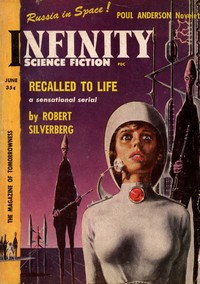
Pangborn's paradox
Written by David Mason
Chaptra reads alongside you — AI insights, chapter breakdowns and reader discussions for every book. Join free
About this book
Reading guide
Themes, characters and key ideas in Pangborn's paradox, written by Chaptra AI.
- about 8 hours
- intermediate
- humorous
- philosophical
- intriguing
David Mason's "Pangborn's Paradox" is a mid-20th century science fiction short story centered on academic characters debating and experimenting with temporal paradoxes. The narrative follows Pangborn, a physicist, who devises an experiment using a temporal transducer to travel back in time and kill his own grandfather, aiming to prove the inherent paradoxes of existence and causality. However, the experiment takes an unexpected turn when, upon confronting his grandfather in the past, Pangborn is shot by the grandfather, who is inexplicably armed and aware of the situation. This twist challenges the initial assumptions about time travel's consequences and leaves both the in-story observers and the reader pondering the nature of causality, free will, and identity. The story concludes with a blend of humor and profound philosophical reflection on the fundamental aspects of time and existence.
“"The very fabric of causality hangs by a thread, gentlemen. It's time we tugged it."”
Key themes
- Temporal Paradoxes and Causality
- The central theme of the story, exploring the logical contradictions inherent in time travel, particularly the grandfather paradox. The narrative initially sets up Pangborn's attempt to create a direct paradox, only to subvert it with an unexpected outcome that forces a re-examination of how causality might operate under such conditions.
- Free Will vs. Determinism
- This theme is profoundly explored through the grandfather's actions. Pangborn's experiment is an attempt to demonstrate a deterministic paradox (if he kills his grandfather, he shouldn't exist). However, the grandfather's awareness and active resistance introduce an element of free will or unexpected agency that disrupts the predetermined outcome, challenging a purely deterministic view of time.
- The Nature of Time and Reality
- Beyond mere paradoxes, the story prompts a deeper inquiry into the fundamental nature of time itself. Is it linear, cyclical, or something more complex? The unexpected twist suggests that reality might have inherent mechanisms to resist logical contradictions, or that our understanding of time is incomplete, leading to a thought-provoking reflection on what constitutes 'existence' when causality is challenged.
Worth discussing
How does Pangborn's experiment challenge our understanding of causality and the grandfather paradox?
Chapter-by-chapter breakdowns, character arcs and the full thematic analysis come with a free account.
Discussions
No one has started one yet
Questions this book opens up
No discussions yet
Be the first to start a discussion about this book!
Sign up to start the discussionReviews
No reviews yet
Be the first to review this book!