
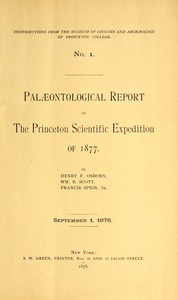
Palæontological Report of the Princeton Scientific Expedition of 1877
Written by Henry Fairfield Osborn,William Berryman Scott,Francis Speir
Chaptra reads alongside you — AI insights, chapter breakdowns and reader discussions for every book. Join free
About this book
Reading guide
Themes, characters and key ideas in Palæontological Report of the Princeton Scientific Expedition of 1877, written by Chaptra AI.
- about 10 hours
- advanced
- Informative
- Scholarly
- Empirical
The 'Palæontological Report of the Princeton Scientific Expedition of 1877' is a seminal late 19th-century scientific publication detailing the findings of a Princeton College geological expedition. Authored by Osborn, Scott, and Speir, it systematically reports on fossil collection and classification, primarily of plants and vertebrates, from the eastern United States, including newly identified species. The report emphasizes the expedition's objectives, the enrichment of Princeton's geological museum, and its contribution to the advancement of paleontology, particularly highlighting fieldwork in Colorado and Wyoming, and the geological significance of the Bridger Basin.
“"The expedition's primary objective was the systematic exploration of the western territories, with a particular focus on enriching the College's geological museum."”
Key themes
- Scientific Discovery and Exploration
- The core theme revolves around the human drive to explore the natural world and uncover its secrets. The expedition itself embodies this theme, showcasing the arduous process of fieldwork, the thrill of discovery, and the meticulous effort required to bring new knowledge to light. It highlights the scientific method as a journey of inquiry.
- Classification and Systematics
- A fundamental theme in paleontology and biology, this report deeply explores the ordering of natural diversity. It details the systematic process of categorizing and describing fossil specimens, which is essential for understanding evolutionary relationships and the structure of past ecosystems. This theme underscores the scientific imperative to create coherent frameworks for understanding the natural world.
- Advancement of Scientific Knowledge
- The overarching purpose of the report is to contribute new data and interpretations to the scientific community. This theme highlights the cumulative nature of science, where each discovery builds upon previous understanding. The authors explicitly state their aim to enrich the geological museum and advance the study of paleontology at Princeton College, demonstrating a commitment to expanding human knowledge.
Worth discussing
How did 19th-century scientific expeditions contribute to the development of disciplines like paleontology?
Chapter-by-chapter breakdowns, character arcs and the full thematic analysis come with a free account.
Discussions
No one has started one yet
Questions this book opens up
No discussions yet
Be the first to start a discussion about this book!
Sign up to start the discussionReviews
No reviews yet
Be the first to review this book!