
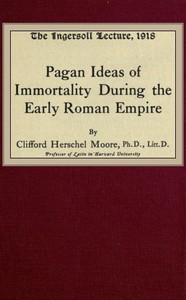
Pagan Ideas of Immortality During the Early Roman Empire
Written by Clifford Herschel Moore
Chaptra reads alongside you — AI insights, chapter breakdowns and reader discussions for every book. Join free
About this book
Reading guide
Themes, characters and key ideas in Pagan Ideas of Immortality During the Early Roman Empire, written by Chaptra AI.
- about 8 hours
- advanced
- Scholarly
- Informative
- Analytical
Clifford Herschel Moore's "Pagan Ideas of Immortality During the Early Roman Empire" is a foundational scholarly work from the early 20th century, meticulously examining the diverse beliefs surrounding the afterlife in the Greco-Roman world. The book comprehensively traces the evolution of these pagan concepts, from early Greek mystery cults and philosophical schools to their sophisticated development during the Roman Empire, heavily drawing on literary and philosophical sources like Virgil's Aeneid and Platonic dialogues. Moore argues that these deeply ingrained pagan notions of the soul's journey, judgment, and reward provided a crucial intellectual and spiritual groundwork. Ultimately, the book asserts that understanding this rich tapestry of pre-existing beliefs is essential for comprehending how early Christian doctrines of immortality were received, adapted, and ultimately took root within the Roman world, rather than emerging in a vacuum.
“"The human spirit, from its earliest awakenings, has grappled with the mystery of death, seeking in every age some assurance of continued existence."”
Key themes
- Syncretism and Evolution of Beliefs
- This theme explores how ideas about immortality were not static but evolved over centuries, blending elements from different cultures, philosophies, and religious traditions. Moore demonstrates how Greek myths, Orphic doctrines, Platonic philosophy, and Roman literary traditions merged to form a complex and diverse understanding of the afterlife.
- Interaction between Paganism and Christianity
- This is a core theme, exploring how the pre-existing pagan beliefs about immortality provided a crucial context for the emergence and reception of early Christian doctrines. Moore argues that pagan thought laid the intellectual and spiritual groundwork, allowing Christian ideas of eternal life to find resonance and take root, despite their unique contributions.
- The Nature of the Soul and Afterlife
- Moore meticulously examines the various conceptions of the soul's nature (e.g., immortal essence, divine spark, shadowy shade) and its fate after death. This includes ideas of bodily resurrection, spiritual survival, metempsychosis, judgment, punishment, and reward, showcasing the wide spectrum of ancient thought on post-mortem existence.
Worth discussing
How did the diverse pagan conceptions of immortality, as explored by Moore, create a receptive environment for early Christian teachings on the afterlife?
Chapter-by-chapter breakdowns, character arcs and the full thematic analysis come with a free account.
Discussions
No one has started one yet
Questions this book opens up
No discussions yet
Be the first to start a discussion about this book!
Sign up to start the discussionReviews
No reviews yet
Be the first to review this book!