
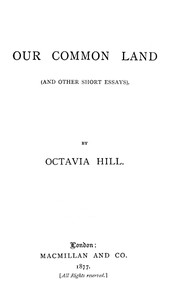
Our Common Land (and Other Short Essays)
Written by Octavia Hill
Chaptra reads alongside you — AI insights, chapter breakdowns and reader discussions for every book. Join free
About this book
Reading guide
Themes, characters and key ideas in Our Common Land (and Other Short Essays), written by Chaptra AI.
- about 7 hours
- intermediate
- Thought-provoking
- Advocacy
- Social commentary
Octavia Hill's "Our Common Land (and Other Short Essays)" is a pivotal collection from the late 19th century, passionately advocating for the preservation of public open spaces and the reform of charitable practices in urban environments, particularly London. Hill vividly illustrates the importance of common lands for the well-being of the poor, contrasting their vital role in public recreation with the threat of enclosure and neglect. Beyond land conservation, the essays critique the impersonal nature of existing charities, proposing a more personal, empathetic, and empowering approach to aid the urban poor. The work serves as a foundational text for social reform, emphasizing the interconnectedness of environment, individual health, and community responsibility.
“"The need of quiet, the need of air, and the sight of sky and of things growing, seem human needs, common to all, and not to be neglected without serious loss."”
Key themes
- Preservation of Common Land and Open Spaces
- This is a central theme, emphasizing the critical importance of public parks, commons, and natural spaces for the physical, mental, and moral health of urban populations. Hill argues that access to nature is a fundamental human need, especially for those living in crowded, polluted cities, and advocates strenuously for legislative protection and public vigilance against their enclosure or destruction.
- Effective and Empathetic Charity
- Hill offers a profound critique of the prevailing charitable practices of her era, which she saw as often impersonal, inefficient, and detrimental to the dignity of recipients. She advocates for a more personal, discerning, and empowering approach, emphasizing the importance of understanding individual circumstances, fostering self-reliance, and avoiding the creation of dependency. Her model involves direct engagement, moral encouragement, and practical assistance that helps people help themselves.
- Urban Well-being and Public Health
- This theme explores the direct correlation between the quality of the urban environment (housing, sanitation, access to nature) and the physical, mental, and moral health of its inhabitants. Hill argues that crowded, unhealthy living conditions and the lack of natural beauty contribute to social ills and diminish human potential, making the provision of better environments a public health imperative.
Worth discussing
How do Hill's arguments for preserving common land resonate with contemporary issues of urban green spaces and environmental justice?
Chapter-by-chapter breakdowns, character arcs and the full thematic analysis come with a free account.
Discussions
No one has started one yet
Questions this book opens up
No discussions yet
Be the first to start a discussion about this book!
Sign up to start the discussionReviews
No reviews yet
Be the first to review this book!