
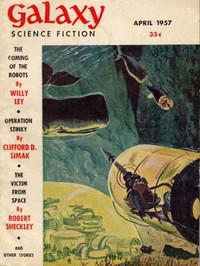
Once a Greech
Written by Evelyn E. Smith
Chaptra reads alongside you — AI insights, chapter breakdowns and reader discussions for every book. Join free
About this book
Reading guide
Themes, characters and key ideas in Once a Greech, written by Chaptra AI.
- about 7 hours
- intermediate
- mysterious
- philosophical
- adventurous
Evelyn E. Smith's mid-20th century science fiction novella, "Once a Greech," explores themes of first contact, identity, and cultural misunderstanding through the lens of interstellar exploration. Captain Iversen and his crew of the 'Herringbone' discover intelligent life on Flimbot, where Lieutenant Harkaway has already established a misguided rapport with the gentle Flimbotzik. Harkaway's naive perceptions lead to escalating tensions, including the abduction of a Flimbotzik child, which he initially believes to be a mere 'greech.' The narrative culminates in a profound transformation, as the greech morphs into an advanced humanoid, challenging established notions of life and consciousness, and hinting at a new cosmic order that transcends physical forms and boundaries.
“"The universe is full of wonders, Captain, if only we look past our preconceptions."”
Key themes
- Cultural Misunderstanding and First Contact
- This theme is central, explored through Lieutenant Harkaway's erroneous perceptions of the Flimbotzik, which lead to significant tensions and the kidnapping of a child. It highlights the dangers of ethnocentrism, projecting human values onto alien cultures, and the necessity of true empathy and careful observation in interspecies interactions.
- Identity and Transformation
- The most striking exploration of this theme is the metamorphosis of the 'greech' from a creature into a young humanoid and ultimately an advanced, transcendent being. This transformation challenges conventional notions of identity, species boundaries, and the fixed nature of self, suggesting life's fluidity and potential for evolution.
- The Nature of Life and Existence
- The novella prompts 'philosophical ponderings about life's ultimate potential, particularly through the greech's final, transcendent state. It suggests that existence is not limited to physical forms or biological definitions, hinting at a higher, interconnected state of being that redefines the cosmic order.
Worth discussing
How does Lieutenant Harkaway's initial perception of the Flimbotzik mirror real-world historical instances of first contact and cultural misunderstanding?
Chapter-by-chapter breakdowns, character arcs and the full thematic analysis come with a free account.
Discussions
No one has started one yet
Questions this book opens up
No discussions yet
Be the first to start a discussion about this book!
Sign up to start the discussionReviews
No reviews yet
Be the first to review this book!