
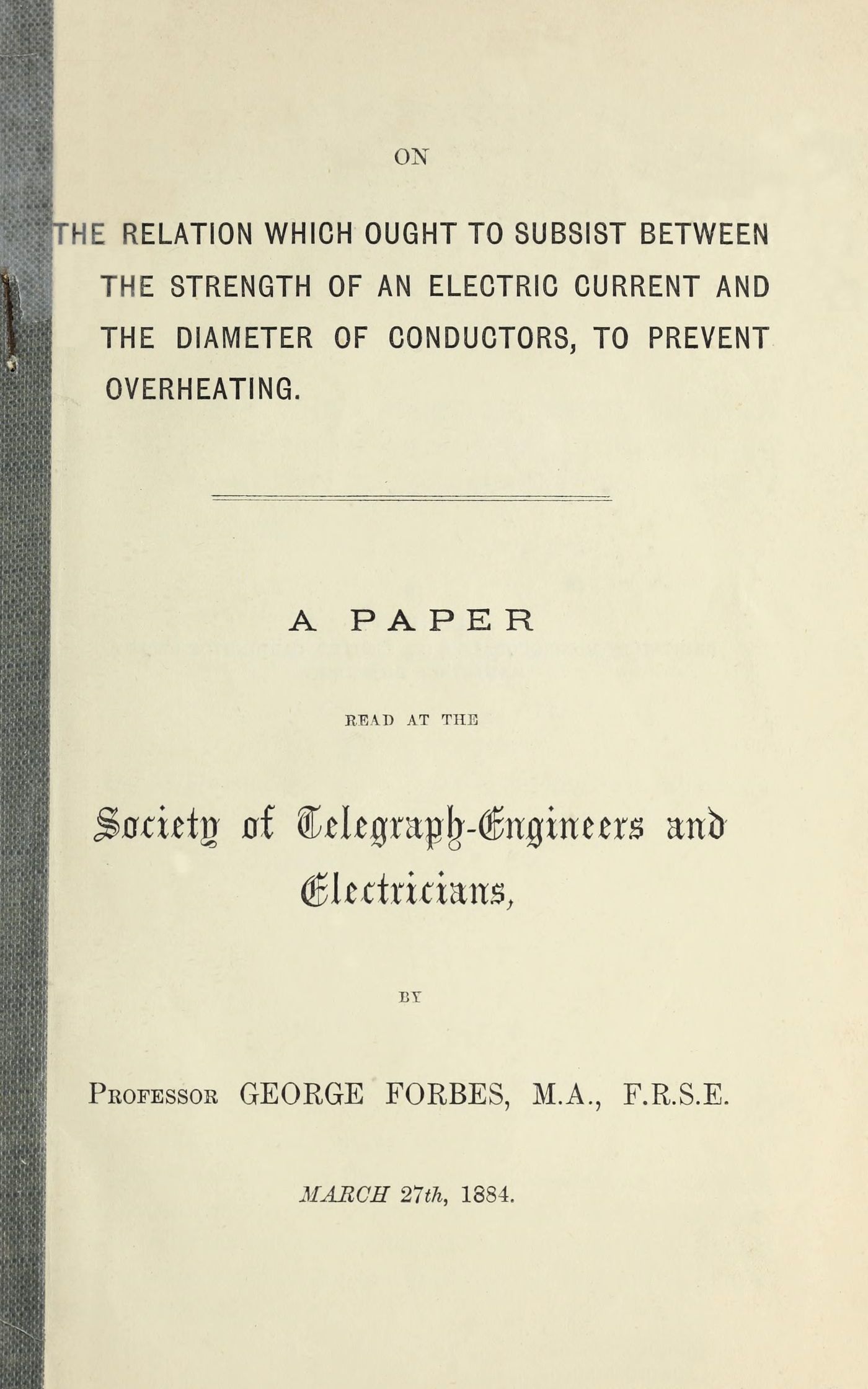
On the relation which ought to subsist between the strength of an electric current and the diameter of conductors, to prevent overheating: A paper read at the Society of Telegraph-Engineers and Electricians, March 27th, 1884.
Written by George Forbes
Chaptra reads alongside you — AI insights, chapter breakdowns and reader discussions for every book. Join free
About this book
This work by Forbes, George offers readers a unique literary experience. The narrative explores themes of electric conductors.
Reading guide
Themes, characters and key ideas in On the relation which ought to subsist between the strength of an electric current and the diameter of conductors, to prevent overheating: A paper read at the Society of Telegraph-Engineers and Electricians, March 27th, 1884., written by Chaptra AI.
- about 8 hours
- advanced
- Informative
- Analytical
- Didactic
George Forbes's 1884 paper addresses a critical challenge in early electrical engineering: determining the safe current-carrying capacity of conductors to prevent overheating and associated hazards. It systematically investigates the relationship between the strength of an electric current and the diameter of the conductor, aiming to establish a quantifiable rule for engineers. Through a combination of theoretical considerations and, implicitly, empirical observation (or reference to such), Forbes proposes a practical formula or guideline, specifically that the current a wire can safely carry varies as its diameter raised to the power of 1.5. This foundational work provided essential safety standards for the burgeoning electrical power industry, contributing significantly to the reliability and safety of early electrical installations.
“This paper is an attempt to lay down some definite rules which may assist engineers in solving this problem.”
Key themes
- Electrical Safety and Engineering Standards
- The central theme is the imperative to ensure the safe operation of electrical systems. Forbes's paper directly addresses the prevention of overheating in conductors, which was a significant cause of fires and hazards in the nascent electrical industry. It highlights the transition from ad-hoc practices to scientifically derived, standardized engineering guidelines.
- Heat Transfer in Conductors
- This theme explores the physical principles governing how electrical energy is converted into heat within a conductor (Joule heating) and how that heat is subsequently dissipated to the environment. Understanding these mechanisms is crucial for predicting and controlling conductor temperature.
- The Dawn of Electrical Engineering and Standardization
- This theme contextualizes Forbes's work within the broader historical period of the late 19th century, when electricity was rapidly being harnessed for practical applications. It highlights the nascent stage of electrical engineering as a distinct discipline and the critical need for scientific inquiry to establish reliable standards and practices.
Worth discussing
Discuss the historical context of electrical engineering in 1884 and the urgent need for papers like Forbes's.
Chapter-by-chapter breakdowns, character arcs and the full thematic analysis come with a free account.
Discussions
No one has started one yet
Questions this book opens up
No discussions yet
Be the first to start a discussion about this book!
Sign up to start the discussionReviews
No reviews yet
Be the first to review this book!