
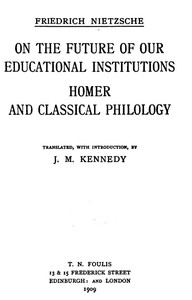
On the Future of our Educational Institutions; Homer and Classical Philology: Complete Works, Volume Three
Written by Friedrich Wilhelm Nietzsche
Chaptra reads alongside you — AI insights, chapter breakdowns and reader discussions for every book. Join free
About this book
Reading guide
Themes, characters and key ideas in On the Future of our Educational Institutions; Homer and Classical Philology: Complete Works, Volume Three, written by Chaptra AI.
- about 8 hours
- advanced
- polemical
- critical
- philosophical
Nietzsche's "On the Future of Our Educational Institutions" is a searing critique of late 19th-century German education, arguing that it had devolved into a utilitarian system serving state interests and mass production rather than fostering true culture and exceptional individuals. Through a series of five lectures, he laments the decline of genuine humanistic learning, particularly classical philology, in favor of specialized, practical training. Nietzsche advocates for an educational reform that prioritizes the cultivation of genius, the development of profound individual minds, and a return to the Hellenic ideal of *Bildung* (self-cultivation) as the foundation for a revitalized German culture. The work is a powerful polemic against the prevailing academic trends and a passionate call for a radical re-evaluation of educational philosophy.
“The German university has become a means to an end, the end being the state.”
Key themes
- Critique of Utilitarian Education
- Nietzsche vehemently criticizes the prevailing educational system for prioritizing practical utility, specialized knowledge, and service to the state over the cultivation of genuine culture and individual intellectual depth. He argues that this focus on 'usefulness' diminishes the human spirit and prevents the emergence of truly great minds.
- Cultivation of Genius and True Culture
- Nietzsche posits that the ultimate purpose of education is to identify, protect, and cultivate exceptional individuals – 'geniuses' – who are capable of leading cultural renewal. He believes that true culture is not a mass phenomenon but the product of the highest individual achievements, and that education should serve this aristocratic ideal rather than aiming for universal mediocrity.
- Importance of Classical Philology and Hellenism
- Nietzsche champions classical philology, particularly the study of ancient Greece and Homer, as the purest path to genuine culture and intellectual rigor. He sees Hellenic culture as embodying a profound tragic wisdom, aesthetic excellence, and a holistic approach to life that is desperately needed to counteract modern superficiality and fragmentation.
Worth discussing
To what extent is Nietzsche's critique of utilitarian education still relevant in contemporary society?
Chapter-by-chapter breakdowns, character arcs and the full thematic analysis come with a free account.
Discussions
No one has started one yet
Questions this book opens up
No discussions yet
Be the first to start a discussion about this book!
Sign up to start the discussionReviews
No reviews yet
Be the first to review this book!