
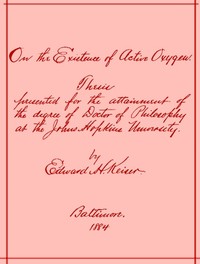
On the Existence of Active Oxygen: Thesis Presented for the Attainment of the Degree of Doctor of Philosophy at the Johns Hopkins University
Written by Edward Harrison Keiser
Chaptra reads alongside you — AI insights, chapter breakdowns and reader discussions for every book. Join free
About this book
Reading guide
Themes, characters and key ideas in On the Existence of Active Oxygen: Thesis Presented for the Attainment of the Degree of Doctor of Philosophy at the Johns Hopkins University, written by Chaptra AI.
- about 8 hours
- advanced
- Analytical
- Skeptical
- Rigorous
Edward Harrison Keiser's doctoral thesis, "On the Existence of Active Oxygen," is a late 19th-century scientific inquiry presented at Johns Hopkins University. It meticulously investigates the prevailing hypothesis of 'active' or 'nascent' oxygen, a state believed to possess stronger oxidizing properties than its ordinary form. Keiser critically reviews existing research from prominent chemists like Schönbein, Baumann, and Remsen, and details his own experiments designed to detect this alleged state. Ultimately, his rigorous analysis leads to the conclusion that the evidence for active oxygen is unsubstantiated, suggesting that observed reactions are better explained by stable compounds like hydrogen dioxide. The work stands as a testament to scientific skepticism and empirical rigor, challenging contemporary assumptions about elemental oxygen.
“A hypothesis, however elegant, must yield to the incontrovertible weight of empirical data.”
Key themes
- Scientific Rigor and Empirical Evidence
- This theme is central to Keiser's thesis, emphasizing the paramount importance of meticulous experimental design, reproducible results, and a critical evaluation of all data. Keiser demonstrates that scientific claims, no matter how widely accepted, must be substantiated by robust empirical evidence and logical deduction, rather than theoretical speculation or ambiguous observations.
- Skepticism in Scientific Inquiry
- Keiser's work champions a healthy scientific skepticism, advocating for the critical questioning of established or widely believed theories, especially when their empirical foundations are weak. He demonstrates that intellectual humility and a willingness to challenge assumptions are crucial for scientific advancement.
- The Evolution of Chemical Understanding
- The thesis illustrates how scientific knowledge is not static but evolves through a process of hypothesis, experimentation, critique, and refinement. Keiser's work represents a pivotal moment in the understanding of oxygen's allotropes and reactivity, moving from a less precise, hypothetical concept to a more accurate, empirically grounded model.
Worth discussing
How does Keiser's thesis exemplify the principles of the scientific method, particularly regarding hypothesis testing and falsifiability?
Chapter-by-chapter breakdowns, character arcs and the full thematic analysis come with a free account.
Discussions
No one has started one yet
Questions this book opens up
No discussions yet
Be the first to start a discussion about this book!
Sign up to start the discussionReviews
No reviews yet
Be the first to review this book!