
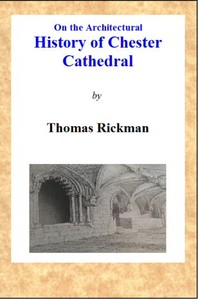
On the Architectural History of Chester Cathedral
Written by Thomas Rickman
Chaptra reads alongside you — AI insights, chapter breakdowns and reader discussions for every book. Join free
About this book
Reading guide
Themes, characters and key ideas in On the Architectural History of Chester Cathedral, written by Chaptra AI.
- about 8 hours
- advanced
- informative
- analytical
- scholarly
Thomas Rickman's "On the Architectural History of Chester Cathedral" is a seminal early 19th-century work dedicated to meticulously documenting and analyzing the architectural evolution of Chester Cathedral. Through detailed observation, Rickman dissects the various structural features and stylistic periods, including Norman, Early English, Decorated, and Perpendicular, tracing the cathedral's construction timeline and modifications. His primary aim is to elevate Chester Cathedral's standing among England's more celebrated ecclesiastical buildings by highlighting its intricate historical narrative and aesthetic beauty. The book serves as a crucial contribution to the burgeoning study of Gothic architecture, reflecting the era's growing interest in understanding historical styles and advocating for the preservation of such significant heritage structures.
“It is in the careful observation of each molding, each arch, and every window tracery that the true narrative of a structure such as Chester Cathedral unfolds.”
Key themes
- Architectural History and Classification
- The foundational theme of the book is the systematic study and classification of architectural styles. Rickman meticulously breaks down the features of Norman, Early English, Decorated, and Perpendicular Gothic, demonstrating how these styles manifest chronologically and structurally within Chester Cathedral. This theme is crucial as Rickman was instrumental in establishing this classification system.
- Preservation and Appreciation of National Heritage
- Rickman's work is an implicit and explicit plea for the recognition and preservation of England's ecclesiastical heritage. By detailing the beauty and historical depth of Chester Cathedral, he advocates for its appreciation and protection, contributing to a growing sentiment in the 19th century for conserving historical monuments.
- The Intrinsic Value of Detailed Observation
- A core tenet of Rickman's methodology, and thus a major theme, is the power and necessity of careful, empirical observation in understanding complex historical artifacts. His analysis is built upon 'careful observation' of structural features, demonstrating that profound insights can be gleaned from meticulous attention to detail.
Worth discussing
How does Rickman's detailed stylistic analysis contribute to our understanding of architectural history as a discipline?
Chapter-by-chapter breakdowns, character arcs and the full thematic analysis come with a free account.
Discussions
No one has started one yet
Questions this book opens up
No discussions yet
Be the first to start a discussion about this book!
Sign up to start the discussionReviews
No reviews yet
Be the first to review this book!