
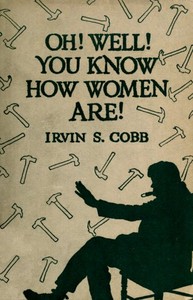
'Oh, Well, You Know How Women Are!'
Written by Mary Roberts Rinehart,Irvin S. (Irvin Shrewsbury) Cobb
Chaptra reads alongside you — AI insights, chapter breakdowns and reader discussions for every book. Join free
About this book
Reading guide
Themes, characters and key ideas in 'Oh, Well, You Know How Women Are!', written by Chaptra AI.
- about 8 hours
- intermediate
- humorous
- witty
- observational
Mary Roberts Rinehart and Irvin S. Cobb's 'Oh, Well, You Know How Women Are!' is a collection of early 20th-century humorous essays that playfully dissect gender dynamics and societal expectations. Through a witty and lighthearted lens, the authors explore common stereotypes and behaviors associated with men and women in everyday life. Cobb's contributions offer satirical observations on women's shopping habits and social interactions, contrasting them with a perceived masculine straightforwardness. Rinehart, in turn, provides a comedic critique of male behaviors and the often-absurd social norms prevalent in a male-dominated society. Ultimately, the book serves as an entertaining yet thoughtful commentary on the human condition, advocating for understanding and harmony between the sexes despite their perceived differences.
“"Oh, the labyrinthine ways of a woman's shopping trip! A man enters with purpose, a woman with a pilgrimage in mind."”
Key themes
- Gender Dynamics and Stereotypes
- This is the core theme of the book, explored through the humorous portrayal of common stereotypes associated with men and women in the early 20th century. Cobb and Rinehart each take a turn dissecting the perceived behaviors, thought processes, and social roles of the opposite sex, highlighting differences in communication, shopping habits, social etiquette, and domestic life. While satirical, the theme delves into the cultural construction of gender.
- Humor as Social Commentary
- The book masterfully uses lighthearted humor, satire, and wit as its primary vehicle for social commentary. Instead of direct criticism, the authors employ exaggeration, irony, and anecdotal observations to expose the absurdities and foibles of both men and women. This approach allows them to address potentially sensitive topics like gender inequality and societal expectations in an accessible and entertaining way, making their observations more palatable and thought-provoking.
- Societal Expectations and Norms
- Beyond individual gender behaviors, the book implicitly explores the broader societal expectations and unwritten norms that shape how men and women are supposed to act. Both authors' essays, by highlighting 'typical' behaviors, reveal the social conditioning prevalent in the early 20th century. They touch upon the pressures to conform to certain roles, whether it's a woman's expected grace and social adeptness or a man's presumed rationality and control.
Worth discussing
How do Cobb and Rinehart use humor to comment on societal expectations of men and women in the early 20th century?
Chapter-by-chapter breakdowns, character arcs and the full thematic analysis come with a free account.
Discussions
No one has started one yet
Questions this book opens up
No discussions yet
Be the first to start a discussion about this book!
Sign up to start the discussionReviews
No reviews yet
Be the first to review this book!