
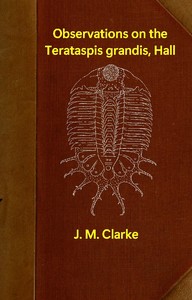
Observations on the Terataspis grandis, Hall, the largest known trilobite
Written by John Mason Clarke
Chaptra reads alongside you — AI insights, chapter breakdowns and reader discussions for every book. Join free
About this book
Read it with a club
Small groups reading the same books and talking as they go.


News
- 1 member
- 1,813 discussions
- Active 2d ago
Read Observations on the Terataspis grandis, Hall, the largest known trilobite alongside people who are reading it too.
Also here: News Bulletin, Just Joking....
Chaptra Prime — paid clubs, every club feature, and unlimited reading support, for $5 a month or $60 once.
See PrimeReading guide
Themes, characters and key ideas in Observations on the Terataspis grandis, Hall, the largest known trilobite, written by Chaptra AI.
- about 8 hours
- advanced
- analytical
- rigorous
- descriptive
John Mason Clarke's "Observations on the Terataspis grandis, Hall, the largest known trilobite" is a seminal late 19th-century scientific publication meticulously detailing the anatomy, ecology, and monumental size of *Terataspis grandis*, an extinct arthropod. Drawing upon fossil fragments discovered in New York and Ontario, Clarke undertakes a rigorous comparative analysis with other large trilobite species to reconstruct its physical characteristics. The work culminates in a proposed restoration suggesting the creature could reach an impressive 24 inches, significantly advancing paleontological understanding of trilobite diversity and evolutionary adaptations. This publication stands as a testament to diligent scientific observation and its crucial role in unraveling the mysteries of prehistoric life.
“"The largest known trilobite, Terataspis grandis, Hall."”
Key themes
- Scientific Inquiry and Meticulous Observation
- The book exemplifies the core principles of scientific inquiry: careful observation of evidence (fossil fragments), systematic analysis, comparative study, and logical deduction leading to a comprehensive understanding. Clarke demonstrates how fragmented data can be synthesized into a coherent scientific narrative through diligent work.
- The Grandeur and Scale of Prehistoric Life
- A central theme is the sheer impressiveness of *Terataspis grandis*'s size, which challenges contemporary perceptions of arthropod dimensions. Clarke highlights how ancient ecosystems harbored life forms of immense scale, fostering a sense of wonder and expanding our understanding of biological diversity throughout geological time.
- Reconstruction and Interpretation in Paleontology
- The book vividly illustrates the process by which paleontologists reconstruct extinct organisms from incomplete fossil records. It explores the blend of scientific data, comparative anatomy, and informed inference required to bring ancient life forms back into conceptual existence, highlighting both the art and science of paleoart and scientific illustration.
Worth discussing
How does Clarke's methodology exemplify the scientific process of observation, analysis, and reconstruction in paleontology?
Chapter-by-chapter breakdowns, character arcs and the full thematic analysis come with a free account.
Discussions
No one has started one yet
Questions this book opens up
No discussions yet
Be the first to start a discussion about this book!
Sign up to start the discussionReviews
No reviews yet
Be the first to review this book!