
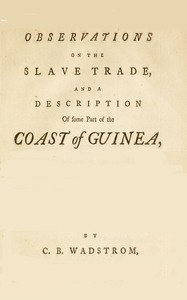
Observations on the slave trade and a description of some part of the coast of Guinea, during a voyage, made in 1787, and 1788, in company with Doctor A. Sparrman and Captain Arrehenius
Written by Carl Bernhard Wadström
Chaptra reads alongside you — AI insights, chapter breakdowns and reader discussions for every book. Join free
About this book
Reading guide
Themes, characters and key ideas in Observations on the slave trade and a description of some part of the coast of Guinea, during a voyage, made in 1787, and 1788, in company with Doctor A. Sparrman and Captain Arrehenius, written by Chaptra AI.
- about 8 hours
- intermediate
- Somber
- Urgent
- Condemnatory
Carl Bernhard Wadström's "Observations on the Slave Trade" is a pivotal late 18th-century historical account detailing his voyage to the Coast of Guinea in 1787-1788. The book offers a firsthand, harrowing exposé of the trans-Atlantic slave trade, meticulously chronicling the brutal methods of slave procurement and the deplorable conditions endured by enslaved individuals. Wadström, a prominent Swedish figure, uses his observations to vehemently condemn the trade, challenging prevailing notions of African inferiority and advocating for their potential through humane treatment and education. Beyond mere critique, the work proposes enlightened solutions, urging for the establishment of new, ethical settlements in Africa focused on cultivation and human development, thereby positioning itself as a powerful abolitionist tract.
“I have myself been a witness to the dreadful scenes of violence and rapine, by which these unhappy people are torn from their native country.”
Key themes
- Abolitionism and Human Rights
- This is the central theme, with Wadström providing an impassioned argument for the immediate cessation of the slave trade based on moral, ethical, and humanitarian grounds. He implicitly and explicitly champions the universal rights of all individuals, regardless of race, to freedom and dignity.
- Critique of Colonialism and Economic Exploitation
- Wadström exposes how European economic interests directly fueled the slave trade, leading to the systematic exploitation of African people and resources. He critiques the destructive impact of this form of engagement on both African societies and European morality, advocating for a more equitable and benevolent form of interaction.
- The Nature of Humanity and Anti-Racism
- A significant aspect of Wadström's argument is his direct challenge to the prevailing racist ideologies of his time, which posited Africans as inherently inferior or 'savage.' He argues that any perceived 'barbarity' is a consequence of the slave trade's dehumanizing effects, not an inherent racial trait, and that Africans, given proper conditions, are capable of flourishing.
Worth discussing
How does Wadström's eyewitness account strengthen the abolitionist argument compared to more theoretical critiques?
Chapter-by-chapter breakdowns, character arcs and the full thematic analysis come with a free account.
Discussions
No one has started one yet
Questions this book opens up
No discussions yet
Be the first to start a discussion about this book!
Sign up to start the discussionReviews
No reviews yet
Be the first to review this book!