
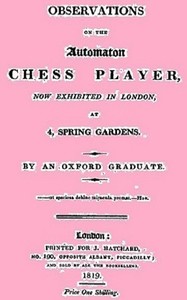
Observations on the Automaton Chess Player Now Exhibited in London, at 4 Spring Gardens
Written by Oxford graduate
Chaptra reads alongside you — AI insights, chapter breakdowns and reader discussions for every book. Join free
About this book
Reading guide
Themes, characters and key ideas in Observations on the Automaton Chess Player Now Exhibited in London, at 4 Spring Gardens, written by Chaptra AI.
- about 8 hours
- advanced
- intriguing
- analytical
- speculative
An early 19th-century scientific publication, "Observations on the Automaton Chess Player" by an Oxford Graduate meticulously investigates Wolfgang von Kempelen's renowned mechanical marvel. The book provides a historical overview of the Automaton Chess Player's creation and its captivating public exhibitions, where it appeared to play chess autonomously. The author delves deeply into the machine's construction and functionality, speculating on the ingenious methods employed to create the illusion of independent thought and strategic play. It serves as both a profound appreciation for a significant technological achievement of its era and a rigorous inquiry into the very nature of mechanical ingenuity and the limits of human perception. Through detailed examination, the text addresses prevailing theories and common misconceptions surrounding the automaton's enigmatic operation.
“The marvel lies not merely in its intricate movements, but in the simulated intellect that appears to guide each strategic decision upon the board.”
Key themes
- Illusion vs. Reality
- Central to the book's inquiry is the profound distinction between what appears to be real and what truly is. The Automaton Chess Player is a masterwork of illusion, designed to deceive the observer into believing it possesses genuine intelligence. The author's primary goal is to dissect this illusion, prompting readers to question their perceptions and understand the mechanisms by which a sophisticated deception can be maintained and believed, even in the face of logical inconsistencies.
- Human Ingenuity and Technological Marvel
- The book deeply explores the extraordinary human capacity for invention and the creation of complex machines. It celebrates Wolfgang von Kempelen's genius in designing a device that could so convincingly mimic human intellect, positioning it as a pinnacle of 18th-century mechanical engineering and a testament to the power of human creativity to push the boundaries of what is thought possible.
- The Nature of Intelligence
- The Automaton Chess Player, by simulating intelligent behavior, directly challenges contemporary understanding of what constitutes 'intelligence,' 'thought,' and 'consciousness.' The book implicitly asks whether a machine can truly think, or if its actions are merely complex reflections of human programming. This theme delves into the philosophical debate about the distinction between organic and artificial intellect, and what it means to possess strategic reasoning and decision-making capabilities.
Worth discussing
How does the book's analysis of the Automaton Chess Player reflect early 19th-century understandings of intelligence and consciousness?
Chapter-by-chapter breakdowns, character arcs and the full thematic analysis come with a free account.
Discussions
No one has started one yet
Questions this book opens up
No discussions yet
Be the first to start a discussion about this book!
Sign up to start the discussionReviews
No reviews yet
Be the first to review this book!