
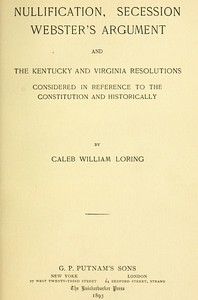
Nullification, Secession, Webster's Argument, and the Kentucky and Virginia Resolutions: Considered in Reference to the Constitution and Historically
Written by Caleb William Loring
Chaptra reads alongside you — AI insights, chapter breakdowns and reader discussions for every book. Join free
About this book
Reading guide
Themes, characters and key ideas in Nullification, Secession, Webster's Argument, and the Kentucky and Virginia Resolutions: Considered in Reference to the Constitution and Historically, written by Chaptra AI.
- about 12 hours
- advanced
- analytical
- historical
- scholarly
Caleb William Loring's work meticulously examines the constitutional doctrines of nullification and secession, tracing their historical roots and theoretical underpinnings. The book provides a detailed analysis of the Kentucky and Virginia Resolutions of 1798 and 1799, pivotal documents in the states' rights debate, and critically evaluates Daniel Webster's influential arguments against these principles. Loring's objective is to consider these concepts in direct reference to the U.S. Constitution and their historical application, ultimately arguing for a particular interpretation of federal power and the Union's indissolubility. It serves as a significant legal and historical treatise on American federalism and the nature of the Union.
“The Constitution of the United States is a compact, not between sovereign states, but between the people of the United States.”
Key themes
- Federal Supremacy vs. States' Rights
- This is the central thematic conflict of the book, exploring the tension between the authority of the federal government and the sovereignty of individual states. Loring meticulously dissects arguments for and against nullification and secession, ultimately advocating for the supremacy of federal law and the indivisibility of the Union, particularly through his analysis of Webster's arguments.
- Constitutional Interpretation
- Loring's work is fundamentally an exercise in constitutional interpretation, examining how different historical figures and factions understood the powers granted to the federal government and reserved to the states. He analyzes various interpretive methodologies, from strict constructionism to more expansive views of federal authority, seeking to establish the 'correct' reading of the Constitution regarding the nature of the Union.
- The Nature of the Union
- This theme explores whether the United States is a confederation of sovereign states or a single, indivisible nation. Loring strongly argues for the latter, using historical and legal analysis to refute the idea that states retain the right to unilaterally nullify federal laws or secede from the Union. His work is a defense of national unity and the perpetuity of the federal government.
Worth discussing
How does Loring interpret the 'compact theory' of the Constitution, and how does this compare to other interpretations?
Chapter-by-chapter breakdowns, character arcs and the full thematic analysis come with a free account.
Discussions
No one has started one yet
Questions this book opens up
No discussions yet
Be the first to start a discussion about this book!
Sign up to start the discussionReviews
No reviews yet
Be the first to review this book!