
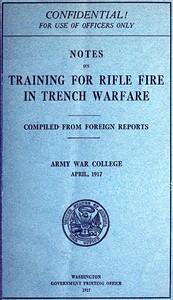
Notes on Training for Rifle Fire in Trench Warfare
Written by Army War College (U.S.)
Chaptra reads alongside you — AI insights, chapter breakdowns and reader discussions for every book. Join free
About this book
Reading guide
Themes, characters and key ideas in Notes on Training for Rifle Fire in Trench Warfare, written by Chaptra AI.
- about 8 hours
- intermediate
- instructive
- serious
- practical
Notes on Training for Rifle Fire in Trench Warfare is a pivotal military training manual published by the U.S. Army War College in April 1917, designed to equip soldiers and officers with essential skills for the brutal realities of World War I trench combat. The manual meticulously outlines tactics and strategies for effective rifle fire, emphasizing the critical importance of individual aimed fire, precision, and concealment in the unique environment of trench warfare. It covers a range of topics from basic rifleman protocols to advanced sniper training, including target recognition, post positioning, and team organization. This comprehensive guide served as a vital resource for enhancing combat efficiency and survival, reflecting the urgent need to adapt to the unprecedented challenges of modern warfare.
“The primary object of fire is to hit the target.”
Key themes
- Efficiency and Precision in Combat
- This theme is central to the entire manual, emphasizing that every shot and every movement must be calculated and effective. It's about maximizing the impact of individual actions within a larger military context, focusing on accuracy, target identification, and strategic positioning to achieve tactical objectives with minimal waste of resources or effort.
- Adaptation to New Warfare
- The manual itself is an embodiment of military adaptation. It addresses the unprecedented challenges of trench warfare—static lines, barbed wire, machine guns, and the need for specialized skills beyond traditional open-field combat. It represents an urgent response to a new form of conflict, devising tactics and training protocols specifically tailored to this brutal environment.
- Survival through Skill and Discipline
- Beyond simply 'winning,' the manual implicitly stresses that individual survival in the trenches is inextricably linked to the mastery of rifle skills and strict adherence to training protocols. Discipline in aiming, concealment, and following orders is presented not just as a means to achieve victory, but as a direct path to personal and unit survival amidst extreme danger.
Worth discussing
How does this manual reflect the specific challenges and innovations of World War I trench warfare?
Chapter-by-chapter breakdowns, character arcs and the full thematic analysis come with a free account.
Discussions
No one has started one yet
Questions this book opens up
No discussions yet
Be the first to start a discussion about this book!
Sign up to start the discussionReviews
No reviews yet
Be the first to review this book!