
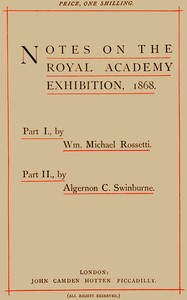
Notes on the Royal Academy Exhibition, 1868
Written by Algernon Charles Swinburne,William Michael Rossetti
Chaptra reads alongside you — AI insights, chapter breakdowns and reader discussions for every book. Join free
About this book
Reading guide
Themes, characters and key ideas in Notes on the Royal Academy Exhibition, 1868, written by Chaptra AI.
- about 10 hours
- advanced
- critical
- analytical
- intellectual
"Notes on the Royal Academy Exhibition, 1868" offers a meticulous critical examination of the art displayed at the Royal Academy, penned by the influential figures William Michael Rossetti and Algernon Charles Swinburne. This mid-19th-century work transcends mere exhibition review, delving into broader observations on British art's evolution, the impact of Pre-Raphaelitism, and shifting artistic standards. Rossetti's introductory premise emphasizes the subjective nature of art criticism, preparing readers for the candid and often provocative assessments within. The compilation merges detailed critiques of individual artworks with profound insights into the balance between technical skill and artistic depth, setting a definitive tone for art discourse of its era.
“"Every piece of art offers its unique narrative and perspective, underscoring the subjective nature of art criticism."”
Key themes
- Art Criticism and Subjectivity
- This theme is foundational to the entire work, explicitly introduced by Rossetti. It explores the inherent difficulty and personal nature of evaluating art, acknowledging that an individual's impressions and perspectives shape their critical judgment. The book itself serves as an extended demonstration of how subjective impressions can be articulated into coherent, if debatable, critical assessments.
- The State and Evolution of British Art
- Beyond individual critiques, the book offers a panoramic view of British painting in the mid-19th century. It discusses prevailing trends, the strengths and weaknesses of the artistic establishment (represented by the Royal Academy), and the general direction in which art was moving. It evaluates whether British art was progressing, stagnating, or finding new directions.
- Technical Skill vs. Artistic Depth
- A central evaluative criterion for Rossetti and Swinburne, this theme explores the distinction between mere craftsmanship and profound artistic expression. The authors frequently assess whether an artwork, despite its technical brilliance, lacks deeper meaning, emotional resonance, or intellectual substance, or conversely, if a piece with less polished technique manages to convey significant depth.
Worth discussing
How do Rossetti and Swinburne's 'Notes' challenge or uphold traditional notions of art criticism in the 19th century?
Chapter-by-chapter breakdowns, character arcs and the full thematic analysis come with a free account.
Discussions
No one has started one yet
Questions this book opens up
No discussions yet
Be the first to start a discussion about this book!
Sign up to start the discussionReviews
No reviews yet
Be the first to review this book!