
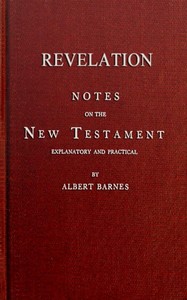
Notes on the New Testament, Explanatory and Practical: Revelation
Written by Albert Barnes
Chaptra reads alongside you — AI insights, chapter breakdowns and reader discussions for every book. Join free
About this book
Reading guide
Themes, characters and key ideas in Notes on the New Testament, Explanatory and Practical: Revelation, written by Chaptra AI.
- about 30 hours
- advanced
- scholarly
- analytical
- didactic
Albert Barnes's "Notes on the New Testament, Explanatory and Practical: Revelation" is a seminal mid-19th-century religious commentary offering a comprehensive, chapter-by-chapter interpretation of the Book of Revelation. Barnes meticulously dissects its complex symbolism and apocalyptic visions, aiming to provide clarity and practical theological understanding for the lay reader and scholar alike. Drawing upon a methodical approach and extensive historical references, including Edward Gibbon's 'Decline and Fall of the Roman Empire,' Barnes endeavors to explain Revelation's prophecies within their historical and theological contexts. The work reflects Barnes's two-decade commitment to biblical exegesis, seeking to illuminate the text without imposing a rigid, predetermined interpretive framework, despite the inherent challenges of the subject matter.
“The object of this work is, as far as possible, to enable the intelligent reader to understand what the Holy Ghost meant in the Revelation of John.”
Key themes
- Divine Sovereignty and Providence
- Barnes consistently emphasizes that despite the chaos and evil depicted, God remains utterly in control. The visions of Revelation, for Barnes, are not random but part of God's overarching plan, unfolding according to His sovereign will. This theme provides comfort and assurance to the reader that God's purposes will ultimately prevail.
- The Persecution and Vindication of the Church
- A central theme Barnes explores is the suffering endured by the early Church and believers throughout history, at the hands of worldly powers. He interprets Revelation as a message of encouragement and assurance that God sees their suffering, will judge their oppressors, and will ultimately vindicate His faithful people.
- Good versus Evil and Ultimate Victory
- Revelation, as interpreted by Barnes, is a grand cosmic drama depicting the ongoing conflict between God and Satan, good and evil. He meticulously outlines the forces of darkness (the Dragon, the Beast, the False Prophet) and their ultimate, decisive defeat by Christ and His angelic forces, culminating in the establishment of God's eternal reign.
Worth discussing
How does Barnes's 19th-century historical context influence his interpretation of Revelation's prophecies, particularly concerning the Roman Empire?
Chapter-by-chapter breakdowns, character arcs and the full thematic analysis come with a free account.
Discussions
No one has started one yet
Questions this book opens up
No discussions yet
Be the first to start a discussion about this book!
Sign up to start the discussionReviews
No reviews yet
Be the first to review this book!