
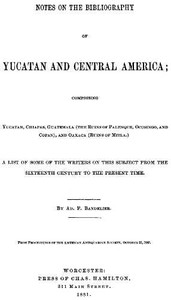
Notes on the Bibliography of Yucatan and Central America: Comprising Yucatan, Chiapas, Guatemala (the Ruins of Palenque, Ocosingo, and Copan), and Oaxaca (Ruins of Mitla)
Written by Adolph Francis Alphonse Bandelier
Chaptra reads alongside you — AI insights, chapter breakdowns and reader discussions for every book. Join free
About this book
Reading guide
Themes, characters and key ideas in Notes on the Bibliography of Yucatan and Central America: Comprising Yucatan, Chiapas, Guatemala (the Ruins of Palenque, Ocosingo, and Copan), and Oaxaca (Ruins of Mitla), written by Chaptra AI.
- about 15 hours
- advanced
- scholarly
- informative
- meticulous
Ad. F. Bandelier's "Notes on the Bibliography of Yucatan and Central America" is a meticulously compiled late 19th-century scholarly work offering a comprehensive bibliographical survey of texts related to Yucatan, Chiapas, Guatemala, and Oaxaca. It systematically catalogs writers and publications from the 16th century to Bandelier's time, focusing on historical events, pre-Columbian antiquities, and indigenous culture. The work emphasizes the critical importance of understanding the historical context, accessibility, and reliability of sources, making it an indispensable resource for researchers in Central American history and indigenous studies. Bandelier's methodological rigor provides a foundational framework for evaluating the evolving literature of the region.
“"The true value of any historical account lies not merely in its content, but in a thorough understanding of the context, motivations, and limitations of its author."”
Key themes
- Historiography and Source Criticism
- This is the core theme, as Bandelier's work is fundamentally about the critical examination of historical sources. He emphasizes the necessity of understanding the context, biases, accessibility, and reliability of texts to construct an accurate historical narrative. The bibliography itself serves as a tool for this critical assessment, guiding readers through the labyrinth of historical documentation.
- The Documentation of Indigenous History and Antiquities
- A significant focus of Bandelier's bibliography is the cataloging and critical review of texts that document the rich pre-Columbian cultures, archaeological sites (such as Palenque, Copan, and Mitla), and the post-conquest life of indigenous peoples in Central America. This theme underscores the historical effort to preserve, interpret, and understand the heritage of these civilizations, often through the lens of colonial observers.
- Colonialism and its Legacy in Historical Narratives
- By tracing the literature from the 16th century, Bandelier implicitly and explicitly highlights how the colonial encounter shaped the initial documentation and subsequent understanding of Central American history. The biases, motivations, and perspectives of European chroniclers, conquerors, and missionaries are integral to the 'evolution of literature' on the region, revealing the complex interplay between power, observation, and historical record-keeping.
Worth discussing
What is the enduring significance of a comprehensive bibliography like Bandelier's in an age of digital information?
Chapter-by-chapter breakdowns, character arcs and the full thematic analysis come with a free account.
Discussions
No one has started one yet
Questions this book opens up
No discussions yet
Be the first to start a discussion about this book!
Sign up to start the discussionReviews
No reviews yet
Be the first to review this book!