
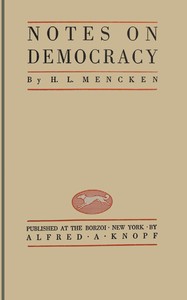
Notes on democracy
Written by H. L. (Henry Louis) Mencken
Chaptra reads alongside you — AI insights, chapter breakdowns and reader discussions for every book. Join free
About this book
Reading guide
Themes, characters and key ideas in Notes on democracy, written by Chaptra AI.
- about 8 hours
- advanced
- sarcastic
- cynical
- provocative
H. L. Mencken's "Notes on Democracy" is a scathing early 20th-century critique of democratic governance, dissecting what he perceives as the inherent flaws and fallacies of the system. Mencken systematically dismantles the idealized notion of "democratic man," arguing that the masses are driven by emotion, self-interest, and a fundamental lack of intelligence rather than rational thought or public virtue. He contends that democracy, far from elevating humanity, caters to the lowest common denominator, fostering mediocrity and enabling demagoguery. Through a blend of sardonic wit, historical observation, and psychological insight, the essay challenges the core tenets of popular rule, presenting a deeply cynical yet intellectually provocative examination of human nature within a democratic framework.
“Democracy is the theory that the common people know what they want, and deserve to get it good and hard.”
Key themes
- The Fallacy of Democratic Man
- This is the core theme, where Mencken directly challenges the foundational assumption of democracy: that the average citizen is rational, virtuous, and capable of intelligent self-governance. He argues that this is a romanticized myth, and that actual human nature, particularly in the aggregate, is driven by emotion, envy, and a desire for conformity, making the masses easily manipulated.
- Critique of Populism and Demagoguery
- Mencken posits that democracy inherently fosters populism and demagoguery because politicians must appeal to the lowest common denominator to gain power. He describes how leaders exploit the fears, prejudices, and ignorance of the masses, rather than appealing to reason or higher ideals, leading to a political landscape dominated by superficiality and manipulation.
- Human Nature and Its Implications for Governance
- This theme explores Mencken's deeply pessimistic view of human nature as the fundamental flaw in democratic theory. He believes that humans are inherently selfish, irrational, and driven by base desires rather than altruism or reason. This view underpins his entire critique, suggesting that any political system built on an optimistic assessment of human capabilities is doomed to fail.
Worth discussing
Mencken argues that democracy caters to the lowest common denominator. Do you agree or disagree, and what evidence do you see in contemporary society?
Chapter-by-chapter breakdowns, character arcs and the full thematic analysis come with a free account.
Discussions
No one has started one yet
Questions this book opens up
No discussions yet
Be the first to start a discussion about this book!
Sign up to start the discussionReviews
No reviews yet
Be the first to review this book!