
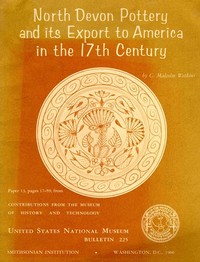
North Devon Pottery and Its Export to America in the 17th Century
Written by C. Malcolm Watkins
Chaptra reads alongside you — AI insights, chapter breakdowns and reader discussions for every book. Join free
About this book
Reading guide
Themes, characters and key ideas in North Devon Pottery and Its Export to America in the 17th Century, written by Chaptra AI.
- about 8 hours
- advanced
- informative
- scholarly
- analytical
C. Malcolm Watkins's "North Devon Pottery and Its Export to America in the 17th Century" is a seminal historical account from the mid-20th century, meticulously documenting the significant transatlantic trade of ceramics between North Devon, England, and the American colonies. The work delves into the cultural importance of these pottery wares, tracing their journey from manufacturing centers like Barnstaple and Bideford to archaeological sites such as Jamestown and Plymouth. Watkins examines distinct pottery types, notably the intricate sgraffito ware and the robust gravel-tempered ware, detailing their production methods and historical context. Through archaeological findings, the book offers profound insights into the daily lives and material culture of early American colonists, underscoring the unexpected global reach of regional English craftsmanship. This publication serves as a foundational text for understanding 17th-century material culture, trade networks, and colonial history.
“The unexpected prominence of North Devon potteries, primarily in Barnstaple and Bideford, in international trade during the 17th century underscores the intricate economic networks of the period.”
Key themes
- Transatlantic Trade & Economic History
- The book meticulously explores the economic networks and trade routes that connected regional English potteries to the burgeoning American colonies in the 17th century. It highlights the scale and significance of this trade, demonstrating how even everyday domestic items were part of a complex global economy.
- Material Culture & Colonial Life
- Watkins uses pottery as a lens through which to examine the daily lives, domestic practices, and cultural identity of early American colonists. The book shows how material possessions, even utilitarian ones, offer profound insights into the social and economic realities of the period.
- Archaeological Discovery & Interpretation
- The book implicitly (and explicitly) champions the role of archaeology in historical research. It demonstrates how systematic excavation, careful identification of artifacts, and comparative analysis are crucial for reconstructing historical narratives, particularly when written records are incomplete or biased.
Worth discussing
How does the study of everyday objects like pottery illuminate broader historical narratives, such as transatlantic trade and colonial life?
Chapter-by-chapter breakdowns, character arcs and the full thematic analysis come with a free account.
Discussions
No one has started one yet
Questions this book opens up
No discussions yet
Be the first to start a discussion about this book!
Sign up to start the discussionReviews
No reviews yet
Be the first to review this book!