
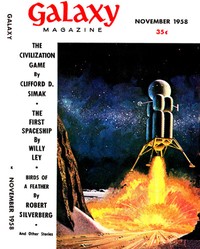
No Substitutions
Written by Jim Harmon
Chaptra reads alongside you — AI insights, chapter breakdowns and reader discussions for every book. Join free
About this book
Reading guide
Themes, characters and key ideas in No Substitutions, written by Chaptra AI.
- about 8 hours
- intermediate
- mysterious
- thought-provoking
- philosophical
Jim Harmon's "No Substitutions" is a thought-provoking science fiction short story set in a future where criminals are confined to an artificial Dreamland, living out fantasies instead of traditional imprisonment. The narrative follows Warden Walker, who oversees this unique penal system, as he grapples with the profound ethical implications of his role. His perception of reality is dramatically challenged when Councilman Coleman suggests Walker himself might be trapped within a Dream. This existential crisis is further complicated by inmates who prefer the artificial reality, forcing Walker to confront the nature of freedom, identity, and the very essence of human existence within a controlled environment.
“Is a perfect illusion more real than an imperfect truth, Warden?”
Key themes
- The Nature of Reality and Perception
- The story profoundly questions what constitutes 'reality' and how our perception shapes it. It explores whether a perfectly simulated world can be considered real, especially when the inhabitants are unaware of its artificiality. Walker's journey blurs the lines between his 'real' world and the inmates' 'Dreamland,' suggesting that reality itself might be subjective or even a construct.
- Morality and Ethics of Control/Punishment
- The story critically examines the ethics of a penal system that offers fantasy instead of traditional punishment. It questions whether benevolent control, even if it eliminates suffering, is morally justifiable if it strips individuals of their agency, identity, and the capacity for authentic experience. It delves into the purpose of punishment: rehabilitation, retribution, or simple removal from society.
- Freedom vs. Confinement
- The narrative explores the nuanced relationship between physical confinement and psychological freedom. It posits that true freedom might not be the absence of physical barriers, but the ability to choose one's reality, even if that reality involves hardship. Conversely, the 'freedom' offered by Dreamland is revealed as a more profound form of confinement, as it limits growth, self-discovery, and authentic connection.
Worth discussing
What are the ethical implications of a penal system like Dreamland? Is it truly more humane than traditional prisons?
Chapter-by-chapter breakdowns, character arcs and the full thematic analysis come with a free account.
Discussions
No one has started one yet
Questions this book opens up
No discussions yet
Be the first to start a discussion about this book!
Sign up to start the discussionReviews
No reviews yet
Be the first to review this book!