
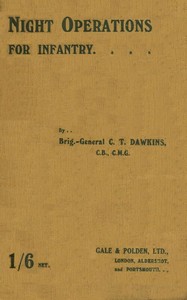
Night Operations for Infantry: Compiled for the Use of Company Officers
Written by C. T. Dawkins
Chaptra reads alongside you — AI insights, chapter breakdowns and reader discussions for every book. Join free
About this book
Reading guide
Themes, characters and key ideas in Night Operations for Infantry: Compiled for the Use of Company Officers, written by Chaptra AI.
- about 8 hours
- advanced
- instructive
- serious
- strategic
C. T. Dawkins' "Night Operations for Infantry" is a pivotal early 20th-century military training guide, specifically tailored for company officers amidst the evolving combat landscape of World War I. The manual systematically addresses the critical need for effective nighttime warfare, a domain increasingly recognized for its strategic importance. Dawkins meticulously outlines techniques for preparation, reconnaissance, and overcoming the inherent psychological challenges soldiers face in darkness. Emphasizing rigorous training and tactical adjustments for both offensive and defensive scenarios, the book provides practical guidance on navigation, communication, the use of auditory cues, and the paramount role of the bayonet in close-quarters combat without gunfire. Beyond its instructional value, it serves as a historical document reflecting the period's advancements in military strategy and the adaptation to modern technological warfare.
“"The cover of darkness, if properly exploited, offers advantages more decisive than any terrain feature."”
Key themes
- Adaptation to Modern Warfare
- The book fundamentally argues that warfare in the early 20th century, particularly World War I, demanded a radical shift in tactics. Night operations were no longer secondary but crucial, requiring specialized methodologies distinct from daytime combat. This theme explores the necessity for military forces to evolve their doctrine and training in response to new battlefield realities and technological contexts.
- Psychology of Combat (Night)
- Dawkins delves into the inherent human fear and disorientation associated with darkness and the unique psychological pressures of night combat. The theme explores how these natural anxieties can be overcome through systematic training, discipline, and the enhancement of other senses. It highlights the importance of mental fortitude and controlled aggression in low-visibility environments.
- Discipline and Training
- Central to the manual is the unwavering belief that rigorous, systematic training and strict discipline are the cornerstones of successful night operations. This theme emphasizes the repetitive practice of drills, the cultivation of obedience, and the development of specialized skills to ensure soldiers can operate effectively and cohesively in the absence of visual cues and under extreme stress.
Worth discussing
How did the technological and tactical landscape of World War I necessitate a specialized focus on night operations, as detailed by Dawkins?
Chapter-by-chapter breakdowns, character arcs and the full thematic analysis come with a free account.
Discussions
No one has started one yet
Questions this book opens up
No discussions yet
Be the first to start a discussion about this book!
Sign up to start the discussionReviews
No reviews yet
Be the first to review this book!