
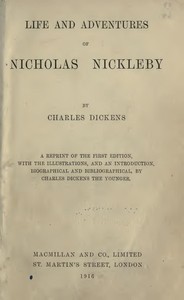
Nicholas Nickleby
Written by Charles Dickens
Chaptra reads alongside you — AI insights, chapter breakdowns and reader discussions for every book. Join free
About this book
Read it with a club
Small groups reading the same books and talking as they go.


News
- 4 members
- 1,813 discussions
- Active Sep 11
Read Nicholas Nickleby alongside people who are reading it too.
Also here: News Bulletin, Just Joking....
Chaptra Prime — paid clubs, every club feature, and unlimited reading support, for $5 a month or $60 once.
See PrimeReading guide
Themes, characters and key ideas in Nicholas Nickleby, written by Chaptra AI.
- about 25 hours
- advanced
- melodramatic
- satirical
- compassionate
Charles Dickens's "Nicholas Nickleby" chronicles the arduous journey of its titular protagonist, a young man thrust into destitution and responsibility after his father's death. Tasked with supporting his mother and sister, Kate, Nicholas confronts the cruelties of Victorian society, particularly the abysmal state of education at Dotheboys Hall and the avarice of his uncle, Ralph Nickleby. The novel follows Nicholas's moral and physical wanderings, his encounters with a vibrant cast of characters both benevolent and malevolent, and his unwavering commitment to justice and family. Ultimately, it is a saga of resilience, the triumph of virtue over vice, and the enduring power of human kindness amidst a world rife with social injustices.
““Subdue your appetites, my dears, and you've conquered human nature.” - Mrs. Squeers”
Key themes
- Social Injustice and Educational Reform
- Dickens uses Dotheboys Hall as a searing indictment of the abuses within the private boarding school system of his time, exposing the cruelty, neglect, and exploitation of children. This theme extends to the broader injustice faced by the poor and vulnerable in Victorian society.
- The Corrupting Power of Greed
- This theme is embodied primarily by Ralph Nickleby, whose insatiable desire for money and power drives him to commit increasingly cruel and manipulative acts, ultimately leading to his own destruction. It explores how avarice can strip away humanity and familial affection.
- Familial Bonds and Loyalty
- The novel contrasts healthy, supportive family relationships (Nicholas and Kate, the Cheerybles) with dysfunctional and destructive ones (Ralph and his estranged son, the Squeers family). It highlights the strength and solace found in genuine affection and loyalty.
Worth discussing
How does Dickens use hyperbole and caricature to depict both good and evil characters? Are these portrayals effective or do they sacrifice complexity?
Chapter-by-chapter breakdowns, character arcs and the full thematic analysis come with a free account.
Discussions
No one has started one yet
Questions this book opens up
No discussions yet
Be the first to start a discussion about this book!
Sign up to start the discussionReviews
No reviews yet
Be the first to review this book!