
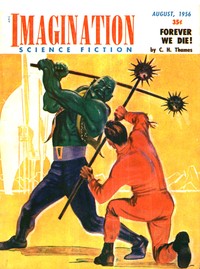
"Next Stop, Nowhere!"
Written by Dick Purcell
Chaptra reads alongside you — AI insights, chapter breakdowns and reader discussions for every book. Join free
About this book
Reading guide
Themes, characters and key ideas in "Next Stop, Nowhere!", written by Chaptra AI.
- about 1 hours
- intermediate
- mysterious
- unsettling
- existential
Dick Purcell's mid-20th century science fiction short story, "Next Stop, Nowhere!", thrusts four unsuspecting individuals—Peggy, Walter, Wilmer, and Fleming—into an extraordinary ordeal when their elevator ride morphs into a surreal journey. Transported to a bizarre new world, they find themselves inexplicably shrunk to minuscule proportions amidst giant, alien surroundings. As they grapple with their terrifying predicament, Fleming Carter, one of the passengers, deduces their shocking new reality: they are now mere 'playthings' in an alternate plane of existence. The narrative culminates with the unsettling revelation that their new purpose is to serve as a unique birthday present, profoundly questioning notions of autonomy, reality, and the very essence of their being.
“A synthesized quote based on Fleming Carter's revelation: 'We are mere playthings, transferred to another plane of existence, destined to serve as an unusual birthday present.'”
Key themes
- Perception and Reality
- This is the core theme, explored through the characters' sudden and inexplicable shift from their familiar world to a bizarre, shrunken existence. The story questions the stability of perceived reality and how easily it can be shattered or redefined. Their experience challenges the very notion of what is 'real' and how our understanding of it is contingent on our environment and scale.
- Loss of Autonomy and Insignificance
- The characters are stripped of all control, agency, and purpose. Their reduction in size and subsequent designation as a 'birthday present' underscores their complete loss of self-determination, becoming objects rather than subjects. This theme explores the terrifying idea of being utterly powerless and having one's existence dictated by unknown, vastly superior entities.
- The Unknown and Cosmic Horror
- The story taps into the primal fear of the unknown, presenting a reality that defies human understanding and logic. The abrupt, inexplicable nature of their predicament, coupled with the overwhelming scale of their new environment, evokes a sense of cosmic horror—the terror of insignificance in a vast, indifferent universe governed by unknowable forces.
Worth discussing
How does the story challenge our understanding of reality and perception?
Chapter-by-chapter breakdowns, character arcs and the full thematic analysis come with a free account.
Discussions
No one has started one yet
Questions this book opens up
No discussions yet
Be the first to start a discussion about this book!
Sign up to start the discussionReviews
No reviews yet
Be the first to review this book!