
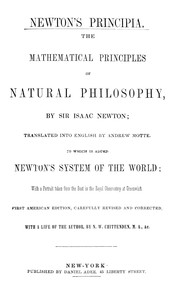
Newton's Principia : $b The mathematical principles of natural philosophy
Written by Isaac Newton
Chaptra reads alongside you — AI insights, chapter breakdowns and reader discussions for every book. Join free
About this book
This work by Newton, Isaac offers readers a unique literary experience. The narrative explores themes of celestial mechanics and mechanics.
Reading guide
Themes, characters and key ideas in Newton's Principia : $b The mathematical principles of natural philosophy, written by Chaptra AI.
- about 8 hours
- advanced
- Intellectual
- Rigorous
- Foundational
Isaac Newton's *Philosophiæ Naturalis Principia Mathematica*, commonly known as the *Principia*, is a monumental work that laid the foundations for classical mechanics and universal gravitation. Published in 1687, it systematically presents Newton's three laws of motion and his law of universal gravitation, demonstrating their application to celestial mechanics and terrestrial phenomena. Through rigorous mathematical proofs and geometric reasoning, Newton unified the heavens and the Earth under a single set of physical laws, explaining planetary orbits, tides, and the motion of projectiles. This seminal text not only revolutionized physics but also established a new paradigm for scientific inquiry, profoundly influencing subsequent scientific thought and the Enlightenment.
“Plato is my friend, Aristotle is my friend, but truth is a greater friend.”
Key themes
- Universal Gravitation
- The central scientific discovery of the *Principia*, asserting that every particle of matter attracts every other particle with a force directly proportional to the product of their masses and inversely proportional to the square of the distance between their centers. This theme unifies celestial and terrestrial mechanics, explaining planetary orbits, tides, and the fall of objects on Earth. It fundamentally changed the understanding of cosmic order.
- Laws of Motion
- The three fundamental laws that govern the motion of all objects in the universe (inertia, F=ma, action-reaction). These laws provide the axiomatic basis for Newton's entire system, defining concepts like force, mass, and acceleration with unprecedented clarity and precision. They represent a radical shift from Aristotelian physics and are essential for understanding mechanical interactions.
- Scientific Method and Empiricism
- Newton's *Principia* is a towering example of the empirical-mathematical method, moving from observed phenomena to general laws through rigorous deduction and then back to predictions. His famous 'Hypotheses non fingo' (I feign no hypotheses) stance emphasized deriving principles from phenomena rather than inventing speculative explanations, distinguishing his work from earlier philosophical traditions.
Worth discussing
How did Newton's *Principia* fundamentally alter humanity's understanding of the cosmos and our place within it?
Chapter-by-chapter breakdowns, character arcs and the full thematic analysis come with a free account.
Discussions
No one has started one yet
Questions this book opens up
No discussions yet
Be the first to start a discussion about this book!
Sign up to start the discussionReviews
No reviews yet
Be the first to review this book!