
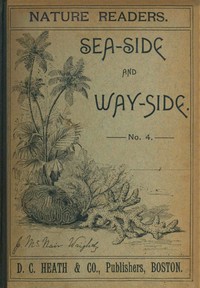
Nature readers : $b Sea-side and way-side. No. 4
Written by Julia McNair Wright
Chaptra reads alongside you — AI insights, chapter breakdowns and reader discussions for every book. Join free
About this book
Reading guide
Themes, characters and key ideas in Nature readers : $b Sea-side and way-side. No. 4, written by Chaptra AI.
- about 8 hours
- intermediate
- educational
- instructive
- curious
Julia McNair Wright's "Nature Readers: Sea-side and Way-side. No. 4" is a late 19th-century educational collection designed to introduce young readers to natural science. Through essays on geology, biology, and astronomy, Wright aims to cultivate observation skills and a deep appreciation for the natural world. The volume opens with a preface emphasizing the beauty and significance of science literature, drawing on historical popularizers and advocating for clear, accessible information for both students and educators. It promotes a dual approach of practical investigation and textual learning, setting a pedagogical stage for inspiring curiosity about the environment.
“The significance and beauty of natural science literature cannot be overstated, for it is through this lens that we truly perceive the world's wonders.”
Key themes
- The Wonders of the Natural World
- This theme is the core impetus for the entire series. Wright aims to instill a profound sense of awe and appreciation for the natural environment, presenting geology, biology, and astronomy not merely as subjects but as sources of endless wonder. The book seeks to unveil the inherent beauty and complexity of the world around us, from the smallest organism to the vastness of the cosmos, encouraging readers to see the extraordinary in the ordinary.
- Science Education and Pedagogy
- Central to Wright's work is the explicit discussion and demonstration of effective methods for teaching science to young people. The preface serves as a manifesto for her educational philosophy, advocating for clarity, engagement, and a balanced approach. This theme explores the very act of learning and teaching, reflecting late 19th-century educational ideals while also positing timeless principles for inspiring intellectual growth.
- Observation and Curiosity
- Wright strongly emphasizes the cultivation of observation skills as a fundamental component of scientific inquiry. This theme encourages active engagement with the environment, urging readers not just to passively absorb information but to keenly observe, question, and explore. Curiosity is presented as the driving force behind discovery, a natural inclination that the book seeks to nurture and direct towards scientific understanding.
Worth discussing
How does Julia McNair Wright's approach to science education compare with modern pedagogical methods?
Chapter-by-chapter breakdowns, character arcs and the full thematic analysis come with a free account.
Discussions
No one has started one yet
Questions this book opens up
No discussions yet
Be the first to start a discussion about this book!
Sign up to start the discussionReviews
No reviews yet
Be the first to review this book!