
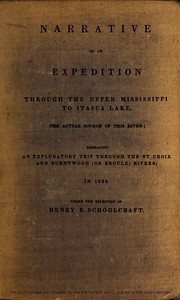
Narrative of an Expedition Through the Upper Mississippi to Itasca Lake, the Actual Source of This River: Embracing an Exploratory Trip Through the St. Croix and Burntwood (or Broule) Rivers
Written by Henry Rowe Schoolcraft
Chaptra reads alongside you — AI insights, chapter breakdowns and reader discussions for every book. Join free
About this book
Read it with a club
Chaptra's history and war clubs — small groups reading the same books and talking as they go.


Footnotes & Firefights
History and war
- 4 members
- 4 discussions
- Active Sep 11
Military history, from grand strategy down to the deeply boring logistics that actually decided everything. This is a Chaptra house club — set up and moderated by us to get the conversation going. Open to everyone; jump in anywhere.
Read Narrative of an Expedition Through the Upper Mississippi to Itasca Lake, the Actual Source of This River: Embracing an Exploratory Trip Through the St. Croix and Burntwood (or Broule) Rivers alongside people who are reading it too.
Also here: Empire, Reconsidered
Chaptra Prime — paid clubs, every club feature, and unlimited reading support, for $5 a month or $60 once.
See PrimeReading guide
Themes, characters and key ideas in Narrative of an Expedition Through the Upper Mississippi to Itasca Lake, the Actual Source of This River: Embracing an Exploratory Trip Through the St. Croix and Burntwood (or Broule) Rivers, written by Chaptra AI.
- about 8 hours
- advanced
- Exploratory
- Historical
- Informative
Henry R. Schoolcraft's "Narrative of an Expedition Through the Upper Mississippi to Itasca Lake" chronicles his pivotal early 19th-century journey to definitively locate the source of the Mississippi River. Beyond its geographical imperative, the expedition was tasked with crucial diplomatic missions, aiming to foster peace between the warring Chippewa and Sioux nations and to gather vital ethnographic and statistical data on indigenous tribes. Schoolcraft's account offers a firsthand perspective on the challenges of frontier exploration, the complexities of inter-tribal relations, and the nascent American efforts to understand and manage its vast western territories. The narrative details his observations of the land, its flora and fauna, and the diverse cultures encountered, culminating in the successful identification of Itasca Lake as the river's true origin.
“Our mission extends beyond mere geographical survey; it is imbued with the higher purpose of pacification among the native nations.”
Key themes
- Exploration and Discovery
- The central theme of the book, focusing on the human drive to explore unknown territories, map the natural world, and uncover geographical mysteries. Schoolcraft's expedition embodies the scientific curiosity and national ambition to fully understand and delineate the vast American continent, culminating in the precise identification of the Mississippi's source.
- Indigenous Relations and Diplomacy
- A critical theme exploring the complex interactions between the U.S. government representatives (Schoolcraft) and various Native American tribes, particularly the Chippewa and Sioux. The narrative highlights the challenges of cross-cultural communication, the pursuit of peace amidst historical conflicts, and the underlying power dynamics of American expansion into indigenous lands.
- Geographic and Scientific Observation
- This theme underscores Schoolcraft's role as a scientist and meticulous observer. The narrative is filled with detailed descriptions of topography, geology, hydrology, flora, and fauna, reflecting the era's emphasis on empirical data collection and the systematic cataloging of the natural world. It showcases the scientific methods employed in early 19th-century expeditions.
Worth discussing
How does Schoolcraft's dual role as explorer and diplomat shape the narrative and his observations?
Chapter-by-chapter breakdowns, character arcs and the full thematic analysis come with a free account.
Discussions
No one has started one yet
Questions this book opens up
No discussions yet
Be the first to start a discussion about this book!
Sign up to start the discussionReviews
No reviews yet
Be the first to review this book!