
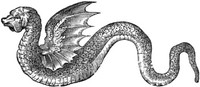
Mythical Monsters
Written by Charles Gould
Chaptra reads alongside you — AI insights, chapter breakdowns and reader discussions for every book. Join free
About this book
Reading guide
Themes, characters and key ideas in Mythical Monsters, written by Chaptra AI.
- about 8 hours
- advanced
- scholarly
- investigative
- speculative
Charles Gould's "Mythical Monsters" is a seminal late 19th-century scientific publication that bridges the gap between ancient mythology and natural history. Deeply influenced by Darwinian principles, the work proposes that many legendary creatures, such as dragons, unicorns, and sea serpents, may not be mere fiction but rather distorted recollections of real animals, including prehistoric species, that coexisted with early humans. Gould meticulously examines various myths, presenting geological and paleontological evidence to argue for the historical existence or inspiration behind these fantastic beings. The book advocates for a paradigm shift in understanding legendary beings, suggesting that scientific advancements can illuminate the factual roots of long-held fantastical narratives rather than dismissing them entirely as imagination.
“The advent of modern scientific understanding, particularly influenced by Darwinian principles, necessitates a radical shift in our perception of legendary beings.”
Key themes
- Science vs. Mythology/Superstition
- This is the core tension of the book, as Gould attempts to demystify mythological creatures by applying scientific principles. He contrasts the traditional, often supernatural, explanations for these beings with evidence-based reasoning from natural history, geology, and paleontology. The theme explores the shift from an age dominated by folklore to one increasingly shaped by empirical observation and Darwinian thought, seeking to replace mystical interpretations with rational, historical explanations.
- The Power of Narrative and Memory
- Gould posits that human memory and oral tradition are powerful, yet fallible, mechanisms that can transform real-world observations into fantastical tales over generations. This theme explores how narratives evolve, become embellished, and blur the lines between fact and fiction, ultimately preserving a kernel of truth in a distorted form. It examines the psychological and cultural processes through which shared experiences are encoded and transmitted, undergoing significant transformation over time.
- Reinterpretation of History through Scientific Lens
- The book fundamentally argues for a re-evaluation of human history and ancient beliefs using contemporary scientific advancements. Gould demonstrates how new discoveries in fields like paleontology, geology, and comparative anatomy can offer alternative, more rational explanations for phenomena previously attributed to magic or pure imagination, thereby rewriting parts of human cultural history. This theme highlights the dynamic nature of historical understanding, constantly reshaped by new evidence and methodologies.
Worth discussing
How has modern science either confirmed or refuted Gould's central hypothesis regarding the origins of mythical monsters?
Chapter-by-chapter breakdowns, character arcs and the full thematic analysis come with a free account.
Discussions
No one has started one yet
Questions this book opens up
No discussions yet
Be the first to start a discussion about this book!
Sign up to start the discussionReviews
No reviews yet
Be the first to review this book!