
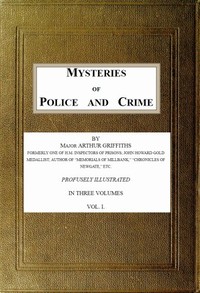
Mysteries of Police and Crime, Vol. 1 (of 3)
Written by Arthur Griffiths
Chaptra reads alongside you — AI insights, chapter breakdowns and reader discussions for every book. Join free
About this book
Reading guide
Themes, characters and key ideas in Mysteries of Police and Crime, Vol. 1 (of 3), written by Chaptra AI.
- about 8 hours
- advanced
- historical
- analytical
- investigative
Arthur Griffiths's "Mysteries of Police and Crime, Vol. 1 (of 3)" is a comprehensive late 19th-century historical account exploring the multifaceted world of crime, its societal impact, and the evolution of law enforcement. Drawing from his unique experience as a former inspector of prisons, Griffiths offers an authoritative examination of criminal motivations, detection methods, and the historical development of police work. The volume establishes crime as a universal and evolving aspect of human society, underscoring the vital role of police in maintaining order. Through a blend of analytical perspective and compelling historical case studies, the book delves into the complexities of justice and morality within the context of crime detection and resolution.
“Crime, in its myriad forms, is but a dark mirror reflecting the evolving complexities of human society, an ever-present shadow to civilization's light.”
Key themes
- The Nature and Evolution of Crime
- Griffiths explores crime not as an anomaly but as an intrinsic, ever-present aspect of human society that evolves alongside civilization. He examines how definitions of crime change, how new forms emerge with technological and social advancements, and its universal presence across cultures and historical periods.
- The Development of Law Enforcement and Detection
- A core theme is the historical progression of police forces and investigative techniques. Griffiths details the necessity of organized law enforcement, tracing its development from rudimentary systems to more sophisticated methods of detection, including early forensics and deductive reasoning. He highlights the ingenuity and perseverance of those combating crime.
- Human Psychology and Criminality
- Griffiths delves into the motivations and minds of criminals, attempting to understand the psychological underpinnings of deviant behavior. While rooted in 19th-century psychological thought, this theme explores the complex interplay of individual will, circumstance, and societal factors that lead to criminal acts.
Worth discussing
How does Griffiths's late 19th-century perspective on crime and human nature compare with contemporary criminological theories?
Chapter-by-chapter breakdowns, character arcs and the full thematic analysis come with a free account.
Discussions
No one has started one yet
Questions this book opens up
No discussions yet
Be the first to start a discussion about this book!
Sign up to start the discussionReviews
No reviews yet
Be the first to review this book!