
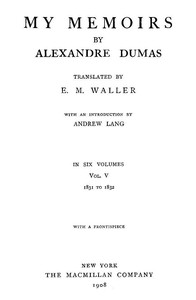
My Memoirs, Vol. V, 1831 to 1832
Written by Alexandre Dumas
Chaptra reads alongside you — AI insights, chapter breakdowns and reader discussions for every book. Join free
About this book
Read it with a club
Small groups reading the same books and talking as they go.


News
- 4 members
- 1,813 discussions
- Active Sep 11
Read My Memoirs, Vol. V, 1831 to 1832 alongside people who are reading it too.
Also here: News Bulletin, Just Joking....
Chaptra Prime — paid clubs, every club feature, and unlimited reading support, for $5 a month or $60 once.
See PrimeReading guide
Themes, characters and key ideas in My Memoirs, Vol. V, 1831 to 1832, written by Chaptra AI.
- about 8 hours
- advanced
- Historical
- Political
- Reflective
Alexandre Dumas's "My Memoirs, Vol. V, 1831 to 1832" offers a vibrant first-person account of France during the early, tumultuous years of the July Monarchy. This volume chronicles Dumas's transition from a mounted national guardsman to a member of the Parisian artillery, immersing readers in the politically charged atmosphere of 1831-1832. Blending personal anecdotes with significant historical events, Dumas recounts his experiences alongside notable figures like General La Fayette and Odilon Barrot, capturing the fervent spirit of activism and camaraderie. The narrative vividly portrays the era's political complexities, including plans to "seize the Chamber," and provides a unique perspective on a pivotal period in French history through the eyes of one of its most celebrated literary figures.
“"The uniform of the artillery, with its martial bearing, seemed to promise not just service, but a true participation in the destiny of France."”
Key themes
- Political Idealism vs. Reality
- This theme explores the tension between the fervent revolutionary ideals and aspirations for a truly liberal government, as embodied by the plans to 'seize the Chamber,' and the complex, often disappointing, realities of political maneuvering, compromise, and the consolidation of power under the July Monarchy. Dumas, as an active participant, reflects on the hopes and frustrations of this period.
- The Formation of Identity
- The memoir details Dumas's personal transformation and the evolution of his identity during a formative period of his life. His transition from a mounted guard to an artilleryman symbolizes a deeper engagement with the political and military realities of his nation, shaping his understanding of himself as a citizen, a writer, and a participant in history.
- The Power of Memory and Narrative
- As a memoir, the book inherently explores the nature of memory itself – how personal experiences are recalled, interpreted, and structured into a narrative. Dumas's act of writing these memoirs years after the events highlights how individual memory contributes to the larger historical record and shapes our understanding of the past.
Worth discussing
How does Dumas's personal involvement in the events of 1831-1832 shape his historical recounting compared to a detached historian's perspective?
Chapter-by-chapter breakdowns, character arcs and the full thematic analysis come with a free account.
Discussions
No one has started one yet
Questions this book opens up
No discussions yet
Be the first to start a discussion about this book!
Sign up to start the discussionReviews
No reviews yet
Be the first to review this book!