
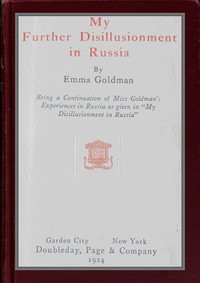
My further disillusionment in Russia
Written by Emma Goldman
Chaptra reads alongside you — AI insights, chapter breakdowns and reader discussions for every book. Join free
About this book
Reading guide
Themes, characters and key ideas in My further disillusionment in Russia, written by Chaptra AI.
- about 10 hours
- advanced
- disillusioned
- critical
- somber
Emma Goldman's "My Further Disillusionment in Russia" serves as a searing indictment of the Bolshevik regime, chronicling her deepening despair with the direction of the Russian Revolution. Following her deportation from the United States, Goldman, a committed anarchist, meticulously documents the stark contrast between revolutionary ideals and the grim realities of Soviet life, including widespread poverty, ruthless suppression of dissent, and the rise of a new authoritarian state. The book details her travels, critical observations of economic and social conditions, and profound interactions with various segments of the populace, culminating in her analysis of the Kronstadt rebellion. Ultimately, it solidifies her conviction that the Bolsheviks had betrayed the revolution's promise, leading to her eventual departure from Russia and a powerful testament against state power.
“If I were to give a summary of our experience in Russia, I would say that the Bolsheviks, in their desire to carry out their theory, have sacrificed the interests of the revolution.”
Key themes
- Disillusionment with Revolution
- This is the overarching theme, as Goldman's book is a testament to her profound disillusionment with the outcome of the Russian Revolution. She arrived with high hopes for a truly free and egalitarian society but witnessed the ideals of workers' control and individual liberty systematically replaced by state control and authoritarianism.
- The Nature of State Power and Authoritarianism
- Goldman's work is a powerful anarchist critique of state power, arguing that any centralized state, regardless of its ideological claims, inevitably leads to oppression. She meticulously details how the Bolshevik state, under the guise of the 'dictatorship of the proletariat,' became a new, more efficient engine of tyranny.
- Individual Freedom vs. Collective Control
- As a lifelong anarchist, Goldman places paramount importance on individual freedom. Her book highlights the tragic conflict between the Bolshevik emphasis on collective control and party discipline, and the anarchist vision of individual autonomy and voluntary association. She argues that true social progress cannot come at the expense of individual liberty.
Worth discussing
To what extent did the Bolsheviks betray the ideals of the Russian Revolution, according to Goldman?
Chapter-by-chapter breakdowns, character arcs and the full thematic analysis come with a free account.
Discussions
No one has started one yet
Questions this book opens up
No discussions yet
Be the first to start a discussion about this book!
Sign up to start the discussionReviews
No reviews yet
Be the first to review this book!