
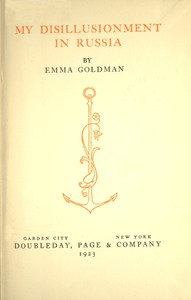
My Disillusionment in Russia
Written by Emma Goldman
Chaptra reads alongside you — AI insights, chapter breakdowns and reader discussions for every book. Join free
About this book
Reading guide
Themes, characters and key ideas in My Disillusionment in Russia, written by Chaptra AI.
- about 10 hours
- intermediate
- disillusioned
- critical
- somber
Emma Goldman's "My Disillusionment in Russia" is a searing memoir detailing her experiences in revolutionary Russia from 1920 to 1921, following her deportation from the United States. Initially arriving with fervent hope for the Bolshevik experiment, Goldman, a lifelong anarchist, soon encounters a stark reality of state repression, bureaucratic inefficiency, and the systematic crushing of revolutionary ideals and individual liberties. The book chronicles her journey across Russia, observing the widespread poverty, the suppression of dissent, and the fundamental philosophical chasm between anarchist principles and the authoritarian practices of the Bolshevik regime. It serves as a powerful testament to the dangers of centralized power and a cautionary tale against the betrayal of revolutionary promises, ultimately leading to Goldman's profound and heartbreaking disillusionment.
“No revolution can ever succeed as a factor of liberation unless the MEANS used to further it are identical in spirit and tendency with the PURPOSES to be achieved.”
Key themes
- Disillusionment with the Bolshevik Revolution
- This is the central theme, chronicling Goldman's painful realization that the Bolshevik regime, far from establishing a free socialist society, had created a new form of state tyranny. She details how the ideals of the revolution—workers' power, freedom of speech, individual liberty—were systematically crushed by the Communist Party, leading to her profound despair and eventual departure.
- Anarchism vs. Bolshevism/State Communism
- Goldman, a lifelong anarchist, uses her experiences to highlight the fundamental ideological conflict between anarchism's emphasis on individual liberty, voluntary association, and decentralized power, and Bolshevism's reliance on a centralized state, dictatorship of the proletariat, and state control. She argues that the latter inevitably leads to repression and the negation of true revolutionary goals.
- The Corrupting Nature of Power
- Goldman meticulously demonstrates how the immense power accumulated by the Bolshevik state and its leaders corrupted the revolutionary project. She shows how revolutionary zeal gave way to bureaucratic inertia, paranoia, and a ruthless determination to maintain power at all costs, leading to the suppression of its own people and the abandonment of its initial liberating promises.
Worth discussing
How does Goldman's anarchist philosophy shape her critique of the Bolshevik Revolution? What are the strengths and weaknesses of this perspective?
Chapter-by-chapter breakdowns, character arcs and the full thematic analysis come with a free account.
Discussions
No one has started one yet
Questions this book opens up
No discussions yet
Be the first to start a discussion about this book!
Sign up to start the discussionReviews
No reviews yet
Be the first to review this book!