
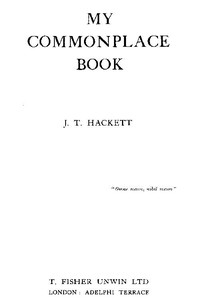
My Commonplace Book
Written by Unknown author
Chaptra reads alongside you — AI insights, chapter breakdowns and reader discussions for every book. Join free
About this book
Read it with a club
Small groups reading the same books and talking as they go.


News
- 4 members
- 1,813 discussions
- Active Sep 11
Read My Commonplace Book alongside people who are reading it too.
Also here: News Bulletin, Just Joking....
Chaptra Prime — paid clubs, every club feature, and unlimited reading support, for $5 a month or $60 once.
See PrimeReading guide
Themes, characters and key ideas in My Commonplace Book, written by Chaptra AI.
- about 8 hours
- intermediate
- reflective
- thought-provoking
- curious
As 'My Commonplace Book' by an unknown author lacks specific textual content, this analysis approaches it as a representative example of the commonplace book genre. Typically, such a book is a personal collection of notes, quotes, observations, reflections, and copied passages from other works, serving as an intellectual scrapbook. It offers a unique, non-linear glimpse into the compiler's mind, interests, and intellectual journey. The book's essence lies in its curated aggregation of wisdom, data, and personal insights, reflecting an individual's engagement with the world of ideas and literature. It is not a narrative with a plot or characters, but rather a mosaic of thought.
“As this is a generic analysis of a commonplace book without specific content, no actual quotes can be provided. However, a typical commonplace book would feature memorable quotes copied from literature, philosophy, history, or science, alongside the compiler's own insightful aphorisms or observations.”
Key themes
- The Pursuit of Knowledge and Wisdom
- This is the overarching theme of any commonplace book. It embodies the compiler's active engagement with learning, their desire to understand the world, and their effort to distill wisdom from various sources. The very act of compilation is an act of seeking and retaining knowledge.
- Memory and Preservation
- A commonplace book serves as an external memory aid, a repository for thoughts, facts, and inspirations that the compiler wishes to retain and revisit. It's an act of preserving fleeting ideas and important insights against the erosion of time, both for personal recall and potentially for future generations.
- Self-Cultivation and Personal Growth
- The act of compiling a commonplace book is often a deeply personal one, aimed at intellectual and moral self-improvement. Through reflection, analysis, and the internalization of others' wisdom, the compiler seeks to refine their own character, understanding, and worldview.
Worth discussing
What is the value of keeping a commonplace book in the digital age? How does it differ from digital note-taking or bookmarking?
Chapter-by-chapter breakdowns, character arcs and the full thematic analysis come with a free account.
Discussions
No one has started one yet
Questions this book opens up
No discussions yet
Be the first to start a discussion about this book!
Sign up to start the discussionReviews
No reviews yet
Be the first to review this book!