
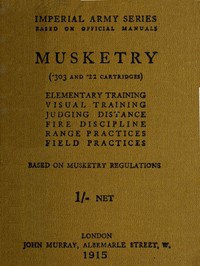
Musketry (.303 and .22 cartridges): Elementary training, visual training, judging distance, fire discipline, range practices, field practices
Written by Unknown author
Chaptra reads alongside you — AI insights, chapter breakdowns and reader discussions for every book. Join free
About this book
Reading guide
Themes, characters and key ideas in Musketry (.303 and .22 cartridges): Elementary training, visual training, judging distance, fire discipline, range practices, field practices, written by Chaptra AI.
- about 12 hours
- intermediate
- instructive
- precise
- practical
This book serves as a foundational manual for musketry training, focusing on practical instruction for both .303 and .22 caliber firearms. It systematically guides the trainee through elementary principles, visual training techniques, accurate distance judging, and the crucial concept of fire discipline. The text culminates in detailed procedures for both range and field practices, aiming to develop a proficient and disciplined marksman. Essentially, it is a comprehensive guide to fundamental rifle marksmanship, emphasizing precision, control, and tactical application.
“Elementary training is the cornerstone of all proficiency.”
Key themes
- Discipline and Precision
- This theme is central to the entire manual, emphasizing that effective marksmanship is a direct result of rigorous discipline in training and precise execution of techniques. It covers everything from breath control and sight alignment to adherence to range safety protocols and fire discipline in the field.
- Progression and Mastery
- The manual is structured as a clear path from novice to expert, illustrating the process of skill acquisition through systematic steps. It underscores the idea that mastery is not inherent but achieved through dedicated learning and practice, building foundational skills before advancing to complex applications.
- Practical Application and Effectiveness
- Beyond mere theoretical knowledge, the manual constantly emphasizes the practical purpose of the training: to be effective in real-world scenarios. Every technique, every drill, is presented with an implicit or explicit goal of improving the marksman's ability to hit targets under varying conditions, whether for sport, defense, or combat.
Worth discussing
How does the manual's structured approach to training compare to modern pedagogical methods for skill acquisition?
Chapter-by-chapter breakdowns, character arcs and the full thematic analysis come with a free account.
Discussions
No one has started one yet
Questions this book opens up
No discussions yet
Be the first to start a discussion about this book!
Sign up to start the discussionReviews
No reviews yet
Be the first to review this book!