
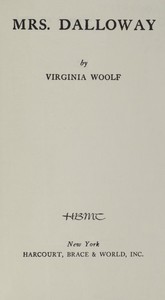
Mrs. Dalloway
Written by Virginia Woolf
Chaptra reads alongside you — AI insights, chapter breakdowns and reader discussions for every book. Join free
About this book
Read it with a club
Chaptra's fiction clubs — small groups reading the same books and talking as they go.


CraxMe Readers Book Club
Fiction
- 385 members
- 227 discussions
- Started December 2025
Welcome to the Readers Book Club. This is an informal group for like-minded people, where you can discuss books, share and recommend, track your reading progress, and lots more. Discuss Books — all about books. Discuss a particular book or genre, share your favourite quotes. Book Reviews — loved a book and highly recommend it? Or was it just average? Share your review and discuss with fellow readers. (May contain spoilers.) Group Reads — what is a book club without a group read! Buddy Reads — planning to read a book and looking for someone to read it with? Post in the Buddy Read request thread, find a reading buddy, and start discussing.
Read Mrs. Dalloway alongside people who are reading it too.
Also here: Doorstops, First Lines Club
Chaptra Prime — paid clubs, every club feature, and unlimited reading support, for $5 a month or $60 once.
See PrimeReading guide
Themes, characters and key ideas in Mrs. Dalloway, written by Chaptra AI.
- about 12 hours
- advanced
- reflective
- poignant
- introspective
Virginia Woolf's "Mrs. Dalloway" unfolds over a single day in June 1923, following Clarissa Dalloway, a high-society woman, as she prepares for her evening party. The novel masterfully employs stream of consciousness to delve into Clarissa's inner world, intertwining her memories, regrets, and perceptions of post-World War I London. Parallel to Clarissa's preparations, the narrative introduces Septimus Warren Smith, a traumatized war veteran grappling with severe shell shock and mental illness, ultimately culminating in tragedy. Through these juxtaposed lives, Woolf explores profound themes of identity, time, mental health, societal expectations, and the fleeting nature of human connection, all against the backdrop of a bustling city.
“Mrs. Dalloway said she would buy the flowers herself.”
Key themes
- Identity and the Self
- Woolf profoundly explores the fragmented and fluid nature of identity, particularly the tension between one's inner self and the external persona presented to society. Clarissa grapples with how her public role as 'Mrs. Dalloway' contrasts with her private thoughts and desires. Septimus, conversely, experiences a complete disintegration of his identity due to trauma, losing his sense of self and connection to the world.
- Time, Memory, and the Past
- The novel is structured around a single day, but time is fluid, constantly shifting between present and past through characters' memories. Woolf illustrates how the past continuously impinges upon and shapes the present, and how memory is not a linear recall but a rich, complex, and often emotional reconstruction. Big Ben's chimes serve as a constant reminder of linear time, contrasting with the subjective, internal experience of memory.
- Mental Health and Trauma
- This theme is powerfully embodied by Septimus Warren Smith, a veteran suffering from severe shell shock (PTSD) after WWI. Woolf depicts his mental deterioration with profound empathy, contrasting his internal suffering with society's lack of understanding and the insensitive, often damaging, medical 'cures' offered. His story is a poignant critique of the societal neglect of war veterans and the stigmatization of mental illness.
Worth discussing
How does Woolf's use of stream of consciousness enhance or challenge your reading experience? How does it reflect the nature of human thought?
Chapter-by-chapter breakdowns, character arcs and the full thematic analysis come with a free account.
Discussions
No one has started one yet
Questions this book opens up
No discussions yet
Be the first to start a discussion about this book!
Sign up to start the discussionReviews
No reviews yet
Be the first to review this book!