
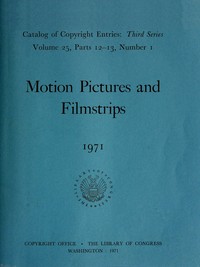
Motion pictures and filmstrips, January-June 1971 : $b Catalog of copyright entries, third series, volume 25, parts 12-13, number 1
Written by Library of Congress. Copyright Office
Chaptra reads alongside you — AI insights, chapter breakdowns and reader discussions for every book. Join free
About this book
Reading guide
Themes, characters and key ideas in Motion pictures and filmstrips, January-June 1971 : $b Catalog of copyright entries, third series, volume 25, parts 12-13, number 1, written by Chaptra AI.
- about 8 hours
- advanced
- Informative
- Systematic
- Historical
This volume, "Motion Pictures and Filmstrips, January-June 1971: Catalog of Copyright Entries," serves as a meticulous governmental record of intellectual property. Produced by the Library of Congress Copyright Office, it systematically lists all copyrighted motion pictures and filmstrips registered during the first half of 1971. The catalog functions as an essential reference tool, detailing production information, legal claims, and key contributors for a diverse range of visual media, from feature films to educational content. It commences with a preface that elucidates the legal framework of U.S. copyright law, guiding users through its organized sections and the comprehensive data provided for each entry, making it an invaluable primary source for legal, historical, and film studies research.
“This catalog provides a detailed record of copyrights for motion pictures and filmstrips...”
Key themes
- Intellectual Property Rights & Copyright Law
- This is the foundational theme, as the entire purpose of the catalog is to document and formalize copyright claims. It highlights the legal framework designed to protect creators' rights, control the distribution and reproduction of their works, and provide a public record of ownership. The preface explicitly details the legal basis, and each entry is a testament to the application of these laws.
- Historical Documentation of Media & Culture
- The catalog serves as a primary historical document, offering a precise snapshot of film and filmstrip production during a specific six-month period. It chronicles what was being created, by whom, and its legal status, thereby contributing to the broader history of visual media and American popular culture. It allows researchers to identify trends, prominent creators, and the types of content deemed worthy of copyright protection in the early 1970s.
- Information Organization & Access
- Beyond merely listing data, the catalog exemplifies meticulous information science. Its systematic categorization, standardized entry format, and detailed indexing (implied by the 'organized list' description) are central to its utility. This theme highlights the importance of methodical approaches to information management to ensure retrievability, accuracy, and accessibility for a specialized user base.
Worth discussing
How do government-published catalogs like this contribute to the preservation of cultural heritage and intellectual history?
Chapter-by-chapter breakdowns, character arcs and the full thematic analysis come with a free account.
Discussions
No one has started one yet
Questions this book opens up
No discussions yet
Be the first to start a discussion about this book!
Sign up to start the discussionReviews
No reviews yet
Be the first to review this book!