
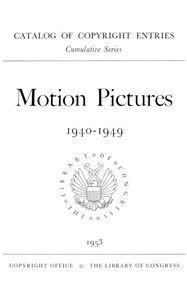
Motion pictures, 1940-1949 : $b Catalog of copyright entries
Written by Library of Congress. Copyright Office
Chaptra reads alongside you — AI insights, chapter breakdowns and reader discussions for every book. Join free
About this book
Reading guide
Themes, characters and key ideas in Motion pictures, 1940-1949 : $b Catalog of copyright entries, written by Chaptra AI.
- about 20 hours
- advanced
- informative
- archival
- systematic
"Motion Pictures, 1940-1949: Catalog of Copyright Entries" is an authoritative, cumulative record compiled by the U.S. Library of Congress Copyright Office. It meticulously documents all motion pictures registered for copyright in the United States during the transformative decade of the 1940s, providing a vital resource for legal, historical, and cinematic research. The catalog serves as a comprehensive inventory, detailing film titles, copyright claimants, production companies, and publication specifics, thereby preserving a critical segment of American film history and intellectual property. Its introduction outlines the catalog's structure and purpose, emphasizing its role in maintaining a public record of creative ownership and the evolution of the film industry.
“"This catalog of copyright entries is published to record the registrations of copyright made in the Copyright Office of the Library of Congress."”
Key themes
- Intellectual Property & Copyright
- The primary purpose of the catalog is to document and protect intellectual property rights for motion pictures. It showcases the legal framework that underpins creative industries, demonstrating how copyright registration establishes ownership, prevents unauthorized use, and facilitates commercial exploitation of films. Each entry is a testament to the legal act of claiming creative work.
- Historical Documentation & Preservation
- The catalog serves as an invaluable historical archive, preserving a detailed record of motion picture production during a critical decade. It ensures that the creative output of the 1940s film industry is not lost to time, providing a factual basis for future historical analysis, film restoration efforts, and cultural studies. It's a tangible link to the past of American cinema.
- The American Film Industry (1940s)
- While not directly analyzing the films, the catalog implicitly reveals the scope, scale, and key players of the American film industry during the 1940s. It provides raw data that can be used to study studio dominance, the rise of independent producers, the types of genres prevalent, and the impact of events like WWII on cinematic output. It's a foundational dataset for understanding Hollywood's Golden Age.
Worth discussing
How does a catalog like this contribute to the preservation of cultural heritage and intellectual property?
Chapter-by-chapter breakdowns, character arcs and the full thematic analysis come with a free account.
Discussions
No one has started one yet
Questions this book opens up
No discussions yet
Be the first to start a discussion about this book!
Sign up to start the discussionReviews
No reviews yet
Be the first to review this book!