
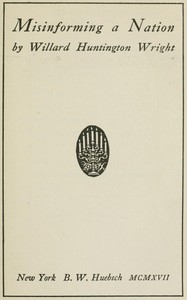
Misinforming a Nation
Written by Willard Huntington Wright
Chaptra reads alongside you — AI insights, chapter breakdowns and reader discussions for every book. Join free
About this book
Reading guide
Themes, characters and key ideas in Misinforming a Nation, written by Chaptra AI.
- about 12 hours
- advanced
- critical
- analytical
- polemical
Willard Huntington Wright's "Misinforming a Nation" is an early 20th-century polemic dissecting the pervasive influence of British cultural hegemony on American intellectual life. Wright argues that British critics systematically belittled American achievements in art, literature, and education, fostering a cultural inferiority complex among Americans. He details how this intellectual colonization, propagated through institutions and reference works like the "Encyclopaedia Britannica," stifled native creativity and appreciation. The book serves as a clarion call for American intellectual independence, urging a re-evaluation of national accomplishments free from a biased, externally imposed worldview. Through a critical examination of various artistic spheres, Wright contends that overcoming this historical subjugation is crucial for America's true intellectual advancement.
“The intellectual colonization of America by England has been so complete that it has stifled our national genius.”
Key themes
- Cultural Colonialism/Hegemony
- This is the central theme, exploring how one nation's culture (Britain's) exerts undue influence and control over another's (America's), not through direct political rule but through intellectual and artistic standards. Wright argues that this 'colonization' stifles native expression and fosters an unhealthy reliance on external validation.
- National Identity and Self-Esteem
- Wright explores how cultural subjugation leads to a national inferiority complex, preventing Americans from recognizing and celebrating their own unique contributions. The book is a plea for the development of a strong, independent American cultural identity, free from external judgments.
- Critique of Authority and Bias in Knowledge
- The book systematically challenges the presumed objectivity and authority of established cultural arbiters, particularly British ones. Wright highlights how personal, national, and historical biases can profoundly shape what is considered 'knowledge' or 'truth' in artistic and intellectual fields.
Worth discussing
How does Wright define 'intellectual colonization' and what evidence does he provide to support his claim?
Chapter-by-chapter breakdowns, character arcs and the full thematic analysis come with a free account.
Discussions
No one has started one yet
Questions this book opens up
No discussions yet
Be the first to start a discussion about this book!
Sign up to start the discussionReviews
No reviews yet
Be the first to review this book!