
Chaptra

The AI reading companion for people who take books seriously

AI insights, chapter breakdowns, community discussions — all in one place.

Join free
Book0 • 300+ pages • 5+ hours reading time

Minority Report of the Committee on Railways in Relation to the Hoosac Tunnel and the Railroads Leading Thereto: With a bill to incorporate the State Board of Trustees of the Hoosac Tunnel Railroad; also the speech delivered by Hon. E. P. Carpenter in the Senate of Massachusetts, June 3, 1873, in support of the same

4.1/5
96 readers on Chaptra have this book

About this book

"Minority Report of the Committee on Railways in Relation to the Hoosac Tunnel…" is a governmental report produced in the early 1870s, likely during the post-Civil War industrial era. It provides insight into the decision-making processes and debates surrounding the management and operation of the Hoosac Tunnel in Massachusetts, a significant project aimed at improving railroad connectivity to facilitate commerce. The report is a political and economic document that addresses the implications of railroad consolidation and state control versus private management. The core content of this report centers on the recommendations made by a minority of the Massachusetts Committee on Railways concerning the future management of the Hoosac Tunnel and the associated rail lines. The authors argue for state control of the tunnel to ensure equal access and fair rates for all users, contrasting their stance with a majority report favoring private consolidation of railroads. They discuss the economic viability of maintaining a state-owned operation, emphasizing the importance of cheap transportation for the growth of Massachusetts' industries. The minority report stresses that effective state management could mitigate the drawbacks associated with private railroad companies, which historically led to inflated costs and monopolistic practices, advocating for a structured approach to ensure equitable service for the public good.
Language
English
Publisher
Project Gutenberg
Release date
Unknown
Downloads
99

More by Massachusetts. General Court. Committee on Railways and Canals

Browse all books by this author

Explore Railroads Books

Discover more Railroads literature
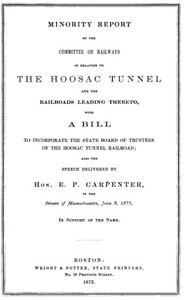
Cover of Minority Report of the Committee on Railways in Relation to the Hoosac Tunnel and the Railroads Leading Thereto: With a bill to incorporate the State Board of Trustees of the Hoosac Tunnel Railroad; also the speech delivered by Hon. E. P. Carpenter in the Senate of Massachusetts, June 3, 1873, in support of the same

Click "Read now" to open in our Reader with AI features.

Community Discussions

Join the conversation about this book

Discussions

0 discussions

Join

No discussions yet

Be the first to start a discussion about this book!

Sign up to start the discussion

AI-Powered Insights

A clearer way to understand Minority Report of the Committee on Railways in Relation to the Hoosac Tunnel and the Railroads Leading Thereto: With a bill to incorporate the State Board of Trustees of the Hoosac Tunnel Railroad; also the speech delivered by Hon. E. P. Carpenter in the Senate of Massachusetts, June 3, 1873, in support of the same through themes, characters, and key ideas

This reading guide highlights what stands out in Minority Report of the Committee on Railways in Relation to the Hoosac Tunnel and the Railroads Leading Thereto: With a bill to incorporate the State Board of Trustees of the Hoosac Tunnel Railroad; also the speech delivered by Hon. E. P. Carpenter in the Senate of Massachusetts, June 3, 1873, in support of the same through 3 core themes, 2 character profiles, and 4 chapter-level ideas. It is meant to help readers decide whether the book fits their taste and deepen the reading once they begin.

AI Reading GuidePreview

About this book

A quick AI guide to “Minority Report of the Committee on Railways in Relation to the Hoosac Tunnel and the Railroads Leading Thereto: With a bill to incorporate the State Board of Trustees of the Hoosac Tunnel Railroad; also the speech delivered by Hon. E. P. Carpenter in the Senate of Massachusetts, June 3, 1873, in support of the same

Get the shape of the book before you commit: what it is about, what mood it carries, and what ideas readers tend to stay with afterward.

~8h readadvancedinformativepersuasiveanalytical

What the book is doing

The 'Minority Report of the Committee on Railways...' is a pivotal 1873 Massachusetts governmental document advocating for state control over the Hoosac Tunnel and its connecting railroads. Produced during the industrial era, it challenges a majority report favoring private consolidation, arguing instead for public ownership to ensure equitable access, fair rates, and prevent monopolistic practices detrimental to the state's economy. The report, supported by Hon. E. P. Carpenter's speech, emphasizes the critical role of cheap transportation for industrial growth and the public good. It presents a detailed economic and political case for a State Board of Trustees to manage the tunnel, aiming to mitigate the historical abuses of private railroad companies and foster broader commercial prosperity within Massachusetts. This historical artifact provides a window into 19th-century debates on infrastructure, public utility, and economic policy.

Key Themes

State Control vs. Private Enterprise

This is the central thematic conflict of the report. It directly contrasts the benefits and drawbacks of allowing private corporations to control vital public infrastructure versus placing that control under state authority. The minority argues for state control to ensure public benefit, while implicitly criticizing the private model's tendency towards monopoly and exploitation.

Economic Development and Public Good

The report fundamentally links the management of the Hoosac Tunnel to the economic prosperity of Massachusetts. It posits that equitable and cheap transportation is essential for the growth of industries, and that this economic development should benefit the entire 'public good' rather than a select few private shareholders. The state's role is framed as ensuring this broader prosperity.

A line worth noting
"The public good, and not private emolument, must be the guiding principle in the management of an enterprise so vital to the Commonwealth's prosperity."
A good discussion starter

What are the historical parallels between the concerns raised in this report and contemporary debates about public utilities or internet infrastructure?

Unlock the full reading guide

See chapter-by-chapter takeaways, deeper character arcs, and a fuller literary analysis built around this book.

Unlock full AI analysis for “Minority Report of the Committee on Railways in Relation to the Hoosac Tunnel and the Railroads Leading Thereto: With a bill to incorporate the State Board of Trustees of the Hoosac Tunnel Railroad; also the speech delivered by Hon. E. P. Carpenter in the Senate of Massachusetts, June 3, 1873, in support of the same

Chapter breakdowns, character deep-dives, and thematic analysis — all in one place.

Reader Reviews

See what others are saying

Reviews

Overall Rating

4.1
2500 ratings

Based on community ratings

No reviews yet

Be the first to review this book!

Readers Also Enjoyed

Discover more books similar to Minority Report of the Committee on Railways in Relation to the Hoosac Tunnel and the Railroads Leading Thereto: With a bill to incorporate the State Board of Trustees of the Hoosac Tunnel Railroad; also the speech delivered by Hon. E. P. Carpenter in the Senate of Massachusetts, June 3, 1873, in support of the same