
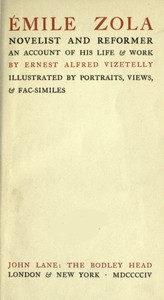
Émile Zola, Novelist and Reformer: An Account of His Life & Work
Written by Ernest Alfred Vizetelly
Chaptra reads alongside you — AI insights, chapter breakdowns and reader discussions for every book. Join free
About this book
Reading guide
Themes, characters and key ideas in Émile Zola, Novelist and Reformer: An Account of His Life & Work, written by Chaptra AI.
- about 8 hours
- advanced
- Informative
- Historical
- Inspiring
Ernest Alfred Vizetelly's "Émile Zola, Novelist and Reformer" offers an early 20th-century biographical exploration of the influential French writer, Émile Zola. The book meticulously chronicles Zola's life, from his challenging childhood marked by familial struggles after his engineer father's death, to his ascent as a literary giant and his unwavering commitment to social justice. Vizetelly aims to illuminate the dual forces of Zola's artistic genius and his reformist zeal, showcasing how these intertwined aspects shaped his prolific career and enduring legacy. It provides critical insights into the motivations behind Zola's naturalistic novels and his courageous stance during significant socio-political events, establishing a comprehensive portrait of a man who profoundly impacted both literature and society.
“"Zola's life was a testament to the power of the pen wielded not merely for art, but as a weapon against injustice."”
Key themes
- Social Reform and Justice
- This is the core theme, exploring Zola's unwavering commitment to exposing and rectifying societal injustices. Vizetelly details how Zola used his literature as a vehicle for social critique, focusing on the plight of the working class, the corruption of institutions, and the need for truth. His involvement in the Dreyfus Affair serves as the ultimate manifestation of this theme, showcasing his willingness to risk everything for justice.
- The Power of Literature and Naturalism
- Vizetelly emphasizes how Zola's literary philosophy, Naturalism, was not merely an artistic style but a powerful method for achieving his reformist goals. The theme explores how Zola believed in portraying life with scientific accuracy, revealing the deterministic forces of heredity and environment, to provoke empathy and demand change. It highlights the profound impact Zola's novels had on public perception and social discourse.
- The Artist's Responsibility and Public Role
- Vizetelly's work portrays Zola as a figure who believed artists have a moral obligation to engage with society and use their platform for good. This theme explores Zola's transformation from a novelist to a public intellectual who actively participated in political discourse, culminating in his courageous stand during the Dreyfus Affair. It examines the personal and professional costs of such a commitment.
Worth discussing
How does Zola's early life and family struggles, as depicted by Vizetelly, contribute to his later motivations as a novelist and reformer?
Chapter-by-chapter breakdowns, character arcs and the full thematic analysis come with a free account.
Discussions
No one has started one yet
Questions this book opens up
No discussions yet
Be the first to start a discussion about this book!
Sign up to start the discussionReviews
No reviews yet
Be the first to review this book!