
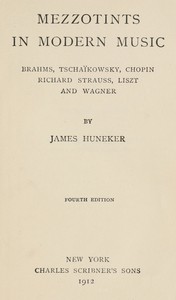
Mezzotints in modern music: $b Brahms, Tschaïkowsky, Chopin, Richard Strauss, Liszt and Wagner
Written by James Huneker
Chaptra reads alongside you — AI insights, chapter breakdowns and reader discussions for every book. Join free
About this book
Reading guide
Themes, characters and key ideas in Mezzotints in modern music: $b Brahms, Tschaïkowsky, Chopin, Richard Strauss, Liszt and Wagner, written by Chaptra AI.
- about 12 hours
- advanced
- Analytical
- Appreciative
- Intellectual
James Huneker's "Mezzotints in Modern Music" is a collection of incisive essays exploring the lives, works, and legacies of pivotal late 19th-century composers. The book opens with a poignant tribute to Johannes Brahms, positioning him as a monumental figure whose contributions to musical form and emotional depth are meticulously examined. Huneker then extends his critical lens to other giants such as Tchaikovsky, Chopin, Richard Strauss, Liszt, and Wagner, dissecting their unique styles, influences, and the broader evolution of music in their era. Through detailed analysis, the work delves into the interplay of structure, expression, and the philosophical underpinnings of each composer's art. It serves as both a historical record and a passionate defense of musical genius, offering readers a deep dive into the intellectual and emotional landscape of modern classical music.
“Brahms, a master architect of sound, whose profound structures belie an even deeper emotional resonance, stands as a titan in the landscape of music.”
Key themes
- The Evolution of Modern Music
- This is the overarching theme, as Huneker chronicles the various paths composers took to move beyond established traditions, exploring new harmonic languages, forms, and expressive possibilities. He examines how each composer contributed to the 'modernity' of music through innovation and artistic bravery.
- The Nature of Musical Genius
- Huneker consistently probes what constitutes genius in music, exploring the unique combination of technical mastery, emotional depth, intellectual rigor, and visionary imagination that defines these composers. He often contrasts different types of genius (e.g., Brahms's structural genius vs. Chopin's poetic genius).
- Structure vs. Emotion in Music
- A recurring tension Huneker examines is the balance or interplay between formal structure and raw emotional expression. He analyzes how composers either adhered to classical forms while infusing them with new feeling (Brahms) or prioritized emotional narrative and programmatic content, often leading to new structures (Liszt, Tchaikovsky, Wagner).
Worth discussing
How does Huneker's critical approach reflect the aesthetic values and intellectual climate of the late 19th and early 20th centuries?
Chapter-by-chapter breakdowns, character arcs and the full thematic analysis come with a free account.
Discussions
No one has started one yet
Questions this book opens up
No discussions yet
Be the first to start a discussion about this book!
Sign up to start the discussionReviews
No reviews yet
Be the first to review this book!