
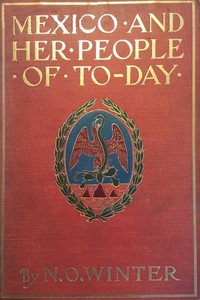
Mexico and Her People of To-day: An Account of the Customs, Characteristics, Amusements, History and Advancement of the Mexicans, and the Development and Resources of Their Country
Written by Nevin O. (Nevin Otto) Winter
Chaptra reads alongside you — AI insights, chapter breakdowns and reader discussions for every book. Join free
About this book
Reading guide
Themes, characters and key ideas in Mexico and Her People of To-day: An Account of the Customs, Characteristics, Amusements, History and Advancement of the Mexicans, and the Development and Resources of Their Country, written by Chaptra AI.
- about 12 hours
- intermediate
- informative
- historical
- descriptive
Nevin O. Winter's "Mexico and Her People of To-day" offers an early 20th-century ethnographic and historical survey of Mexico, written in the wake of the Porfirio Diaz dictatorship. The book comprehensively explores the nation's diverse customs, characteristics, and daily life, alongside its rich historical legacy from ancient civilizations to colonial rule and independence. Winter delves into Mexico's unique geography, vast natural resources, and economic development, aiming to provide American readers with a nuanced understanding of the country and its people. It serves as a valuable historical document, reflecting contemporary perceptions and the author's efforts to bridge cultural gaps.
“"Mexico, with her ancient civilizations and modern aspirations, presents a fascinating study of contrasts, where the echoes of Aztec drums mingle with the hum of nascent industry."”
Key themes
- Cultural Identity and Heritage
- The book extensively explores the complex cultural identity of Mexico, emphasizing the blend of its ancient indigenous roots (e.g., Aztec, Mayan) with the profound influence of Spanish colonialism. Winter examines how this dual heritage manifests in customs, language, religion (Catholicism infused with indigenous practices), and social structures, attempting to define a distinct 'Mexican character' that is a synthesis of these forces.
- Cross-Cultural Understanding and Misconceptions
- A driving force behind Winter's writing is the explicit aim to dispel misconceptions about Mexico among American readers. He seeks to provide a more nuanced and informed understanding of Mexican people, culture, and society, moving beyond simplistic or prejudiced views. This theme highlights the author's role as a cultural interpreter, attempting to bridge the gap between two neighboring nations with often complex and strained relations.
- Modernization vs. Tradition
- Winter's account captures Mexico at a pivotal moment, transitioning from the long dictatorship of Porfirio Diaz into a period of revolutionary upheaval and modernization. The book frequently highlights the tension and coexistence of centuries-old traditions—in agriculture, daily life, and social customs—with nascent industrialization, infrastructural development, and political reform. It explores how new technologies and ideas began to penetrate a society deeply rooted in its past.
Worth discussing
How does Winter's portrayal of Mexico reflect early 20th-century American perceptions and biases towards Latin American countries?
Chapter-by-chapter breakdowns, character arcs and the full thematic analysis come with a free account.
Discussions
No one has started one yet
Questions this book opens up
No discussions yet
Be the first to start a discussion about this book!
Sign up to start the discussionReviews
No reviews yet
Be the first to review this book!