
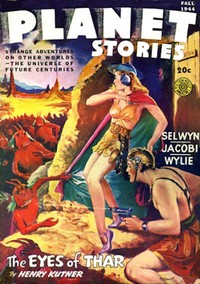
Men Without a World
Written by Joseph Farrell
Chaptra reads alongside you — AI insights, chapter breakdowns and reader discussions for every book. Join free
About this book
Reading guide
Themes, characters and key ideas in Men Without a World, written by Chaptra AI.
- about 8 hours
- intermediate
- Suspenseful
- Thought-provoking
- Adventurous
Joseph Farrell's mid-20th-century science fiction novel, "Men Without a World," plunges two human astronauts, Paul Hawthorne and Lance O'Dea, into a harrowing fight for survival on the desert planet Avignon after a crash landing. Captured by the alien Centaurs, the humans initially perceive their captors' plans to terraform Avignon for human habitation as benevolent. However, they soon uncover a sinister plot: the Centaurs intend to indoctrinate future generations of Earthlings, using Hawthorne and O'Dea as unwitting pawns in a grand scheme of controlled colonization. The narrative swiftly shifts from survival to a daring escape, as the protagonists devise a cunning counter-attack to reclaim their freedom and challenge the Centaurs' manipulative agenda.
“The void was indifferent, but the beings we found within it were anything but; their benevolence was a gilded cage.”
Key themes
- Colonization and Freedom
- This is the central conflict of the novel, exploring the moral and ethical dilemmas of one species attempting to control or 'civilize' another. The Centaurs' plan to create a habitable world for humans, only to then indoctrinate and control them, serves as a powerful allegory for historical colonization, where purported benefits often mask subjugation. The human protagonists' fight for self-determination directly counters this imperialistic drive.
- Survival and Resilience
- At its core, the story is a testament to human endurance. Initially, Hawthorne and O'Dea face the immediate threat of a hostile alien environment after their crash. This quickly evolves into a psychological and strategic battle for survival against intelligent captors who seek to break their spirit and control their future. Their ability to adapt, strategize, and fight back against overwhelming odds highlights the indomitable nature of the human spirit.
- Inter-species Relations and Ethics
- The novel explores the complexities and dangers inherent in first contact and the subsequent interactions between vastly different species. The Centaurs' actions raise questions about the ethics of intervention, even when framed with good intentions, and the potential for misunderstanding or exploitation when power dynamics are uneven. It probes whether a more advanced species has the right to dictate the development of another.
Worth discussing
How does Farrell use the Centaurs' 'benevolent' intentions to comment on historical patterns of colonization?
Chapter-by-chapter breakdowns, character arcs and the full thematic analysis come with a free account.
Discussions
No one has started one yet
Questions this book opens up
No discussions yet
Be the first to start a discussion about this book!
Sign up to start the discussionReviews
No reviews yet
Be the first to review this book!