
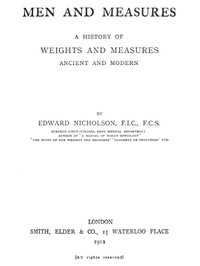
Men and Measures
Written by Edward Nicholson
Chaptra reads alongside you — AI insights, chapter breakdowns and reader discussions for every book. Join free
About this book
Reading guide
Themes, characters and key ideas in Men and Measures, written by Chaptra AI.
- about 12 hours
- advanced
- Informative
- Scholarly
- Historical
Edward Nicholson's "Men and Measures" offers a meticulous historical journey through the evolution of weights and measures, tracing their development from rudimentary, anthropometric standards in ancient civilizations to the sophisticated metric and imperial systems of the modern era. The book emphasizes the profound relationship between human anatomy and early measurement concepts, such as the cubit and span, before detailing the transition to more standardized and precise units. Nicholson meticulously explores the cultural, scientific, and societal implications of these evolving systems, highlighting their critical role in trade, governance, and scientific advancement. It serves as an exhaustive account of humanity's continuous quest for accuracy and uniformity in quantifying the world.
“"The human body, in its various parts, provided the earliest and most natural standards of measurement, a testament to humanity's innate desire to quantify its world."”
Key themes
- The Quest for Standardization and Precision
- This theme explores humanity's enduring drive to create consistent, accurate, and universally accepted units of measurement. Nicholson illustrates how this quest, motivated by trade, science, and governance, led from highly variable, localized systems to globally recognized standards. It highlights the challenges and triumphs inherent in achieving consensus on such fundamental concepts.
- Interconnectedness of Culture and Measurement
- Nicholson demonstrates that measurement systems are not merely technical tools but deeply embedded cultural artifacts. They reflect the values, daily lives, technological capabilities, and even the anatomies of the societies that created them. The evolution of measures is shown to be intertwined with social customs, economic necessities, and political structures.
- The Impact of Measurement on Civilization
- Nicholson argues that the evolution of measurement systems is inextricably linked to the advancement of human civilization itself. Accurate and standardized measures facilitated complex engineering projects, enabled fair trade, supported taxation and governance, and were indispensable for scientific discovery. The book illustrates how sophisticated societies could only emerge with equally sophisticated means of quantification.
Worth discussing
How do early, anthropometric measurements reflect the scientific and cultural understanding of ancient civilizations?
Chapter-by-chapter breakdowns, character arcs and the full thematic analysis come with a free account.
Discussions
No one has started one yet
Questions this book opens up
No discussions yet
Be the first to start a discussion about this book!
Sign up to start the discussionReviews
No reviews yet
Be the first to review this book!