
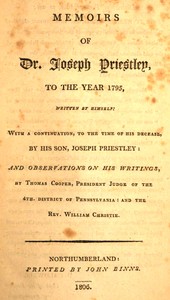
Memoirs of Dr. Joseph Priestley : $b To the year 1795, written by himself: with a continuation, to the time of his decease, by his son, Joseph Priestley: and observations on his writings, by Thomas Cooper, President Judge of the 4th. district of Pennsylvania: and the Rev. William Christie.
Written by Joseph Priestley
Chaptra reads alongside you — AI insights, chapter breakdowns and reader discussions for every book. Join free
About this book
Reading guide
Themes, characters and key ideas in Memoirs of Dr. Joseph Priestley : $b To the year 1795, written by himself: with a continuation, to the time of his decease, by his son, Joseph Priestley: and observations on his writings, by Thomas Cooper, President Judge of the 4th. district of Pennsylvania: and the Rev. William Christie., written by Chaptra AI.
- about 15 hours
- advanced
- intellectual
- reflective
- historical
Joseph Priestley's 'Memoirs' offers a compelling first-person account of an eminent 18th-century scientist and theologian, detailing his intellectual journey, personal struggles, and significant contributions to both science and liberal religion. The memoir chronicles his early life, education, and pivotal shift from Calvinism to Unitarianism, emphasizing his commitment to free inquiry and virtue. Continued by his son and commented upon by contemporaries, the work provides a multifaceted portrait of a man at the forefront of Enlightenment thought, navigating societal and religious controversies. It is an invaluable historical document, shedding light on the intersection of scientific discovery, theological debate, and personal conviction in a transformative era.
“I consider myself as a man, and a citizen, and therefore, as having a right to think and act for myself, as far as I do not interfere with the rights of others.”
Key themes
- The Pursuit of Knowledge and Scientific Inquiry
- Central to Priestley's life, this theme explores his relentless curiosity and empirical approach to understanding the natural world. His memoir details his experiments, discoveries (like oxygen), and the methodology that defined the burgeoning scientific revolution. It showcases his belief that scientific discovery is a pathway to understanding divine order.
- Religious Freedom and Dissent
- This theme is paramount, chronicling Priestley's journey from orthodox Calvinism to Unitarianism. It underscores his unwavering commitment to individual conscience, intellectual inquiry in matters of faith, and his critique of established religious dogma. His experiences with persecution highlight the societal resistance to religious innovation.
- Autobiographical Reflection and Self-Fashioning
- The memoir itself is an exploration of this theme. Priestley consciously constructs his narrative to present his life as a coherent intellectual and moral journey, often justifying his controversial positions. It's an act of self-definition and legacy building, showing how individuals craft their own stories for posterity.
Worth discussing
How does Priestley's memoir illustrate the interconnectedness of scientific inquiry and religious belief in the 18th century?
Chapter-by-chapter breakdowns, character arcs and the full thematic analysis come with a free account.
Discussions
No one has started one yet
Questions this book opens up
No discussions yet
Be the first to start a discussion about this book!
Sign up to start the discussionReviews
No reviews yet
Be the first to review this book!