
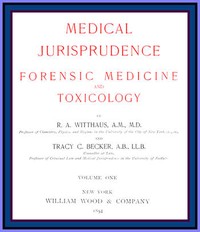
Medical Jurisprudence, Forensic medicine and Toxicology. Vol. 1
Written by R. A. (Rudolph August) Witthaus,Tracy C. (Tracy Chatfield) Becker
Chaptra reads alongside you — AI insights, chapter breakdowns and reader discussions for every book. Join free
About this book
Reading guide
Themes, characters and key ideas in Medical Jurisprudence, Forensic medicine and Toxicology. Vol. 1, written by Chaptra AI.
- about 8 hours
- advanced
- Informative
- Academic
- Analytical
R. A. Witthaus and Tracy C. Becker's "Medical Jurisprudence, Forensic Medicine and Toxicology. Vol. 1" is a seminal late 19th-century scientific publication that comprehensively explores the intricate connections between medical science and legal practice. It serves as a foundational reference, elucidating how medical knowledge is applied within legal frameworks, particularly in areas like expert testimony and the statutory regulation of medical professionals. The volume systematically introduces the historical development and core concepts of medical jurisprudence, forensic medicine, and toxicology, emphasizing the critical need for clear legal definitions governing medical practice. Aimed at both legal and medical practitioners, as well as scholars, this work underscores the evolving rights and duties of physicians and its enduring significance for understanding legal medicine's historical and practical dimensions.
“"Medical Jurisprudence, Forensic Medicine, and Toxicology represent the essential convergence where the healing arts meet the principles of justice."”
Key themes
- Intersection of Medicine and Law
- This theme is central to the entire volume, exploring how medical knowledge, practices, and ethics are applied within legal contexts. It examines the mechanisms by which medical evidence informs legal decisions, from criminal investigations to civil disputes, and how legal frameworks regulate medical practice.
- The Role of Expert Testimony
- The book places significant emphasis on the critical function of medical professionals as expert witnesses. It details the duties, responsibilities, and challenges associated with providing objective, scientific opinions in a legal setting, highlighting the necessity for physicians to translate complex medical findings into understandable legal terms.
- Historical Evolution of Legal Medicine
- The volume traces the historical development of medical jurisprudence, forensic medicine, and toxicology, illustrating how these fields emerged and professionalized over time. This historical perspective provides context for the contemporary practices and legal frameworks, showing the gradual integration of scientific methods into legal processes.
Worth discussing
How did late 19th-century advancements in medicine and science necessitate the formalization of medical jurisprudence?
Chapter-by-chapter breakdowns, character arcs and the full thematic analysis come with a free account.
Discussions
No one has started one yet
Questions this book opens up
No discussions yet
Be the first to start a discussion about this book!
Sign up to start the discussionReviews
No reviews yet
Be the first to review this book!